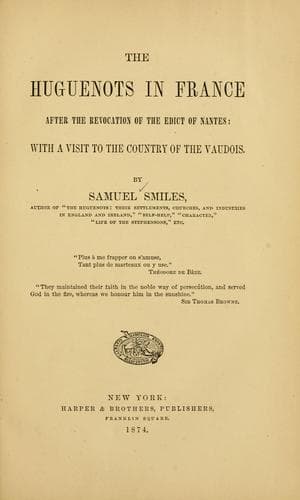
Dauphiné (France) -- Description and travel; Huguenots; Waldenses
An engagement took place at Newton Butler. The Enniskillen horse swept
the Irish troops before them. Fifteen hundred were put to the sword,
and four hundred prisoners were taken. Seven pieces of cannon,
fourteen barrels of powder, and all the drums and colours were left in
the hands of the victors. The Irish army were then at Strabane, on
their retreat from Londonderry. They at once struck their tents, threw
their military stores into the river, and set out in full retreat for
the south.
In the meantime a French fleet had landed at Bantry Bay, with three
thousand men on board, and a large convoy of ammunition and
provisions. William III., on his part, determined, with the consent of
the English Parliament, to send a force into Ireland to encounter the
French and Irish forces under King James.
William's troops consisted of English, Scotch, Dutch, and Danes, with
a large admixture of French Huguenots. There were a regiment of
Huguenot horse, of eight companies, commanded by the Duke of
Schomberg, and three regiments of Huguenot foot, commanded by La
Mellonière, Du Cambon, and La Caillemotte. Schomberg, the old Huguenot
chief, was put in command of the entire force.
Rapin accompanied the expedition as a cadet. The army assembled at
Highlake, about sixteen miles from Chester. About ninety vessels of
all sorts were assembled near the mouth of the Dee. Part of the army
was embarked on the 12th of August, and set sail for Ireland. About
ten thousand men, horse and foot, were landed at Bangor, near the
southern entrance to Belfast Lough. Parties were sent out to scour the
adjacent country, and to feel for the enemy. This done, the army set
out for Belfast.
James's forces had abandoned the place, and retired to Carrickfergus,
some ten miles from Belfast, on the north coast of the Lough.
Carrickfergus was a fortified town. The castle occupies a strong
position on a rock overlooking the Lough. The place formed a depôt for
James's troops, and Schomberg therefore determined to besiege the
fortress.
Rapin has written an account of William's campaigns in England and
Ireland; but with becoming modesty he says nothing about his own
achievements. We must therefore supply the deficiency. Before the
siege of Carrickfergus, he had been appointed ensign in Lord
Kingston's regiment. He was helped to this office by his uncle Daniel,
who accompanied the expedition. Several regiments of Schomberg's army
were detached from Belfast to Carrickfergus, to commence the siege.
Among these was Lord Kingston's regiment.
Public-domain text, read in full here on John Shaqi.
Reviews
Reviews
No reviews yet
Be the first to share your thoughts on this work.
Elsewhere in the archive
Join the Discussion
Join the discussion
Sign in to leave a comment or review.
Sign InorCreate an account