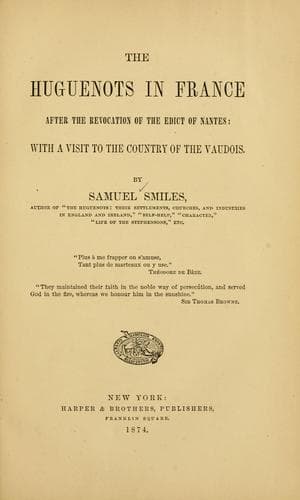
Dauphiné (France) -- Description and travel; Huguenots; Waldenses
Rey was at first thrown into prison at Anduze, when, after a brief
examination by the local judge, he was entrusted to thirty soldiers,
to be conveyed to Alais. There he was subjected to further
examination, avowing that he had preached wherever he had found
faithful people ready to hear him. At Nismes, he was told that he had
broken the law, in preaching contrary to the King's will. "I obey the
law of the King of kings," he replied; "it is right that I should obey
God rather than man. Do with me what you will; I am ready to die."
The priests, the judges, and other persons of influence endeavoured to
induce him to change his opinions. Promises of great favours were
offered him if he would abjure; and when the intendant Baville
informed him of the frightful death before him if he refused, he
replied, "My life is not of value to me, provided I gain Christ." He
remained firm. He was ordered to be put to the torture. He was still
unshaken. Then he was delivered over to the executioner. "I am
treated," he said, "more mildly than my Saviour."
On his way to the place of execution, two monks walked by his side to
induce him to relent, and to help him to die. "Let me alone," he said,
"you annoy me with your consolations." On coming in sight of the
gallows at Beaucaire, he cried, "Courage, courage! the end of my
journey is at hand. I see before me the ladder which leads to
heaven."
The monks wished to mount the ladder with him. "Return," said he, "I
have no need of your help. I have assistance enough from God to take
the last step of my journey." When he reached the upper platform, he
was about, before dying, to make public his confession of faith. But
the authorities had arranged beforehand that this should be prevented.
When he opened his mouth, a roll of military drums muffled his voice.
His radiant look and gestures spoke for him. A few minutes more, and
he was dead; and when the paleness of death spread over his face, it
still bore the reflex of joy and peace in which he had expired. "There
is a veritable martyr," said many even of the Catholics who were
witnesses of his death.
It was thought that the public hanging of a pastor would put a stop to
all further ministrations among the Huguenots. But the sight of the
bodies of their brethren hung on the nearest trees, and the heads of
their pastors rolling on the scaffold, did not deter them from
continuing to hold religious meetings in solitary places, more
especially in Languedoc, Viverais, and the provinces in the south-east
of France.
Between the year 1686, when Fulcran Rey was hanged at Beaucaire, and
the year 1698, when Claude Brousson was hanged at Montpellier, not
fewer than seventeen pastors were publicly executed; namely, three at
Nismes, two at St. Hippolyte and Marsillargues in the Cevennes, and
twelve on the Peyrou at Montpellier--the public place on which
Protestant Christians in the South of France were then principally
executed.
Public-domain text, read in full here on John Shaqi.
Reviews
Reviews
No reviews yet
Be the first to share your thoughts on this work.
Join the Discussion
Join the discussion
Sign in to leave a comment or review.
Sign InorCreate an account