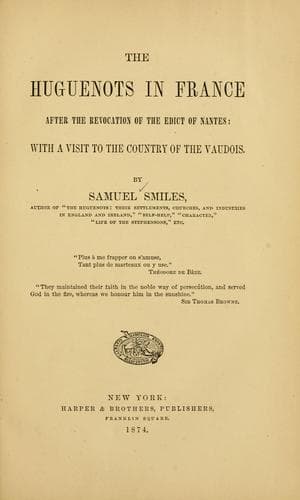
Dauphiné (France) -- Description and travel; Huguenots; Waldenses
At last the Irish troops slowly retreated up the hill. The French
troops had scarcely been engaged. Sarsfield implored James to put
himself at their head, and make a last fight for his crown. Six
thousand fresh men coming into action, when the army of William was
exhausted by fatigue, might have changed the fortune of the day. But
James would not face the enemy. He put himself at the head of the
French troops and Sarsfield's regiment--the first occasion on which he
had led during the day--and set out for Dublin, leaving the rest of
his army to shift for themselves.
The Irish army now poured through the Pass of Duleek. They were
pursued by Count Schomberg at the head of the left wing of William's
army. The pursuit lasted several miles beyond the village of Duleek,
when the Count was recalled by express orders of the King. The Irish
army retreated in good order, and they reached Dublin in safety. James
was the first to carry thither the news of his defeat. On reaching
Dublin Castle, he was received by Lady Tyrconnel, the wife of the
Viceroy. "Madam," said he, "your countrymen can run well." "Not quite
so well as your Majesty," was her retort, "for I see that you have won
the race."
The opinion of the Irish soldiers may be understood from their saying,
after their defeat, "Change generals, and we will fight the battle
over again." "James had no royal quality about him," says an able
Catholic historian; "nature had made him a coward, a monk, and a
gourmand; and, in spite of the freak of fortune that had placed him on
a throne, and seemed inclined to keep him there, she vindicated her
authority, and dropped him ultimately in the niche that suited him--
'The meanest slave of France's despot lord.'"
William halted on the field that James had occupied in the morning.
The troops remained under arms all night. The loss of life was not so
great as was expected. On William's side not more than four hundred
men were killed; but amongst them were Duke Schomberg, Colonel
Caillemotte, and Dr. George Walker, the defender of Derry. "King
James's whole loss in this battle," says Rapin, "was generally
computed at fifteen hundred men, amongst whom were the Lord Dungan,
the Lord Carlingford, Sir Neil O'Neil, Colonel Fitzgerald, the Marquis
d'Hocquincourt, and several prisoners, the chief of whom was
Lieutenant-General Hamilton, who, to do him justice, behaved with
great courage, and kept the victory doubtful, until he was taken
prisoner."
On the following day Drogheda surrendered without resistance. The
garrison laid down their arms, and departed for Athlone. James stayed
at Dublin for a night, and on the following morning he started for
Waterford, causing the bridges to be broken down behind him, for fear
of being pursued by the allied forces. He then embarked on a
ship-of-war, and was again conveyed to France.
Public-domain text, read in full here on John Shaqi.
Reviews
Reviews
No reviews yet
Be the first to share your thoughts on this work.
Elsewhere in the archive
Join the Discussion
Join the discussion
Sign in to leave a comment or review.
Sign InorCreate an account