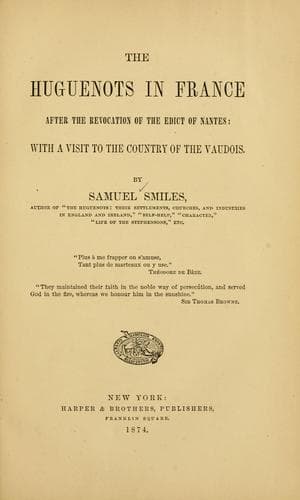
Dauphiné (France) -- Description and travel; Huguenots; Waldenses
William's army proceeded slowly to Dublin. The Duke of Ormond entered
the city two days after the battle of the Boyne, at the head of nine
troops of horse. On the next day the King, with his whole army,
marched to Finglas, in the neighbourhood of Dublin; and on the 6th of
July he entered the city, and proceeded to St. Patrick's Church, to
return thanks for his victory.
The whole of the Irish army proceeded towards Athlone and Limerick,
intending to carry on the war behind the Shannon. William sent a body
of his troops, under Lieutenant-General Douglas, to Athlone, while he
himself proceeded to reduce and occupy the towns of the South. Rapin
followed his leader, and hence his next appearance at the siege of
Athlone.
Rapin conducted himself throughout the Irish campaign as a true soldier.
He was attentive, accurate, skilful, and brave. He did the work he had
to do without any fuss; but he _did_ it. Lieutenant-General Douglas,
under whom he served, soon ascertained his merits, saw through his
character, and became much attached to him. He promoted him to the rank
of aide-de-camp, so that he might have this able Frenchman continually
about his person.
Douglas proceeded westward, with six regiments of horse and ten of
foot, to reduce Athlone. But the place was by far too strong for so
small a force to besiege, and still less to take it. Athlone had
always been a stronghold. For centuries the bridge and castle had
formed the great highway into Connaught. The Irish town is defended on
the eastern side by the Shannon, a deep and wide river, almost
impossible to pass in the face of a hostile army.
Douglas summoned the Irish garrison to surrender. Colonel Richard
Grace, the gallant old governor, returned a passionate defiance.
"These are my terms," he said, discharging a pistol at the messenger:
"when my provisions are consumed, I will defend my trust until I have
eaten my boots."
Abandoning as indefensible the English part of the town, situated on
the east side of the Shannon, Grace set fire to it, and retired with
all his forces to the western side, blowing up an arch of the bridge
behind him. The English then brought up the few cannon they had with
them, and commenced battering the walls. The Irish had more cannon,
and defended themselves with vigour. The besiegers made a breach in
the castle, but it was too high and too small for an assault.
"Notwithstanding this," says Rapin, "the firing continued very brisk
on both sides; but the besiegers having lost Mr. Neilson, their best
gunner, and the cavalry suffering very much for want of forage; and at
the same time it being reported that Sarsfield was advancing with
fifteen thousand men to relieve the place, Douglas held a council of
war, wherein it was thought fit to raise the siege, which he
accordingly did on the 25th, having lost near four hundred men before
the town, the greatest part of whom died of sickness."
Public-domain text, read in full here on John Shaqi.
Reviews
Reviews
No reviews yet
Be the first to share your thoughts on this work.
Elsewhere in the archive
Join the Discussion
Join the discussion
Sign in to leave a comment or review.
Sign InorCreate an account