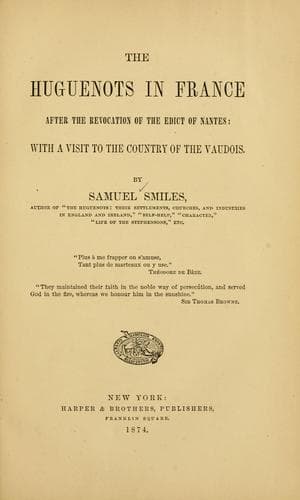
Dauphiné (France) -- Description and travel; Huguenots; Waldenses
Rapin was severely wounded. A musket shot hit him in the shoulder, and
completely disabled him. His brother Solomon was also wounded. His
younger brother fell dead by his side. They belonged to the "forlorn
hope," and were volunteers in the assault on the breach. Rapin was
raised to the rank of captain.
The siege of Limerick was at once raised. The heavy baggage and cannon
were sent away on the 30th of August, and the next day the army
decamped and marched towards Clonmel. The King intrusted the command
of his army to Lieutenant-General Ginckel, and set sail for England
from Duncannon Fort, near Waterford, on the 5th of September.
The campaign was not yet over. The Earl of Marlborough landed near
Cork with four thousand men. Reinforced by four thousand Danes and
French Huguenots, he shortly succeeded in taking the fortified towns
of Cork and Kinsale. After garrisoning these places the Earl returned
to England.
General Ginckel went into winter quarters at Mullingar, in Westmeath.
The French troops, under command of Count Lauzun, went into Galway.
Lauzun shortly after returned to France, and St. Ruth was sent over to
take command of the French and Irish army. But they hung about Galway
doing nothing. In the meantime Ginckel was carefully preparing for the
renewal of the campaign. He was reinforced by an excellent body of
troops from Scotland, commanded by General Mackay. He was also well
supplied, through the vigilance of William, with all the necessaries
of war.
Rapin's friend, Colonel Lord Douglas, pressed him to accompany him to
Flanders as his aide-de-camp; but the wound in his shoulder still
caused him great pain, and he was forced to decline the appointment.
Strange to say, his uncle Pélisson--the converter, or rather the
buyer, of so many Romish converts in France--sent him a present of
fifty pistoles through his cousin M. de la Bastide, which consoled him
greatly during his recovery.
General Ginckel broke up his camp at Mullingar at the beginning of
June, and marched towards Athlone. The Irish had assembled a
considerable army at Ballymore, about midway between Mullingar and
Athlone. They had also built a fort there, and intended to dispute the
passage of Ginckel's army. A sharp engagement took place when his
forces came up. The Irish were defeated, with the loss of over a
thousand prisoners and all their baggage.
Public-domain text, read in full here on John Shaqi.
Reviews
Reviews
No reviews yet
Be the first to share your thoughts on this work.
Elsewhere in the archive
Join the Discussion
Join the discussion
Sign in to leave a comment or review.
Sign InorCreate an account