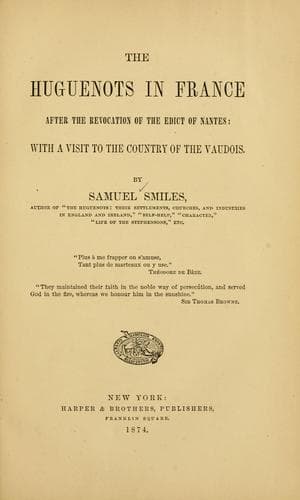
Dauphiné (France) -- Description and travel; Huguenots; Waldenses
Ginckel then appeared before Athlone, but the second resistance of the
besieged was much less successful than the first. St. Ruth, the French
general, treated the Irish officers and soldiers under his command
with supercilious contempt. He admitted none of their officers into
his councils. He was as ignorant of the army which he commanded as of
the country which he occupied. Nor was he a great general. He had been
principally occupied in France in hunting and hanging the poor
Protestants of Dauphiny and the Cevennes. He had never fought a
pitched battle; and his incapacity led to the defeat of the Irish at
Athlone, and afterwards at Aughrim.
St. Ruth treated his English adversaries with as much contempt as he
did his Irish followers. When he heard that the English were about to
cross the Shannon, he said "it was impossible for them to take the
town, and be so near with an army to succour it." He added that he
would give a thousand louis if they _durst_ attempt it. To which
Sarsfield retorted, "Spare your money and mind your business; for I
know that no enterprise is too difficult for British courage to
attempt."
Ginckel took possession of the English town after some resistance,
when the Irish army retreated to the other side of the Shannon.
Batteries were planted, pontoons were brought up, and the siege began
with vigour. Ginckel attempted to get possession of the bridge. One of
the arches was broken down, on the Connaught side of the river. Under
cover of a heavy fire, a party of Ginckel's men succeeded in raising a
plank-work for the purpose of spanning the broken arch. The work was
nearly completed, when a sergeant and ten bold Scots belonging to
Maxwell's Brigade on the Irish side, pushed on to the bridge; but they
were all slain. A second brave party was more successful than the
first. They succeeded in throwing all the planks and beams into the
river, only two men escaping with their lives.
Ginckel then attempted to repair the broken arch by carrying a close
gallery on the bridge, in order to fill up the gap with heavy planks.
All was ready, and an assault was ordered for next day. It was
resolved to cross the Shannon in three places--one body to cross by
the narrow ford below the bridge, another by the pontoons above it,
while the main body was to force the bridge itself. On the morning of
the intended crossing, the Irish sent a volley of grenades among the
wooden work of the bridge, when some of the fascines took fire, and
the whole fabric was soon in a blaze. The smoke blew into the faces of
the English, and it was found impossible to cross the river that day.
Public-domain text, read in full here on John Shaqi.
Reviews
Reviews
No reviews yet
Be the first to share your thoughts on this work.
Elsewhere in the archive
Join the Discussion
Join the discussion
Sign in to leave a comment or review.
Sign InorCreate an account