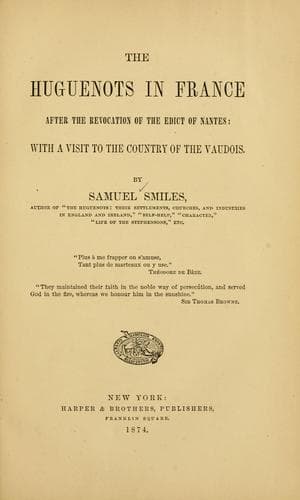
Dauphiné (France) -- Description and travel; Huguenots; Waldenses
M. De Félice, however, will not believe that the Revocation of the
Edict of Nantes was popular in France. He takes a much more patriotic
view of the French people. He cannot believe them to have been
wilfully guilty of the barbarities which the French Government
committed upon the Huguenots. It was the King, the priests, and the
courtiers only! But he forgets that these upper barbarians were
supported by the soldiers and the people everywhere. He adds, however,
that if the Revocation _were_ popular, "it would be the most
overwhelming accusation against the Church of Rome, that it had thus
educated and fashioned France."[19] There is, however, no doubt
whatever that the Jesuits, during the long period that they had the
exclusive education of the country in their hands, _did_ thus fashion
France; for, in 1793, the people educated by them treated King,
Jesuits, priests, and aristocracy, in precisely the same manner that
they had treated the Huguenots about a century before.
[Footnote 19: De Felice's "History of the Protestants of
France," book iii. sect. 17.]
CHAPTER III.
CLAUDE BROUSSON, THE HUGUENOT ADVOCATE.
To give an account in detail of the varieties of cruelty inflicted on
the Huguenots, and of the agonies to which they were subjected for
many years before and after the passing of the Act of Revocation,
would occupy too much space, besides being tedious through the mere
repetition of like horrors. But in order to condense such an account,
we think it will be more interesting if we endeavour to give a brief
history of the state of France at that time, in connection with the
biography of one of the most celebrated Huguenots of his period, both
in his life, his piety, his trials, and his endurance--that of Claude
Brousson, the advocate, the pastor, and the martyr of Languedoc.
Claude Brousson was born at Nismes in 1647. He was designed by his
parents for the profession of the law, and prosecuted his studies at
the college of his native town, where he graduated as Doctor of Laws.
He commenced his professional career about the time when Louis XIV.
began to issue his oppressive edicts against the Huguenots. Protestant
advocates were not yet forbidden to practise, but they already
laboured under many disabilities. He continued, however, for some time
to exercise his profession, with much ability, at Castres,
Castelnaudry, and Toulouse. He was frequently employed in defending
Protestant pastors, and in contesting the measures for suppressing
their congregations and levelling their churches under existing
edicts, some time before the Revocation of the Edict of Nantes had
been finally resolved upon.
Public-domain text, read in full here on John Shaqi.
Reviews
Reviews
No reviews yet
Be the first to share your thoughts on this work.
Join the Discussion
Join the discussion
Sign in to leave a comment or review.
Sign InorCreate an account