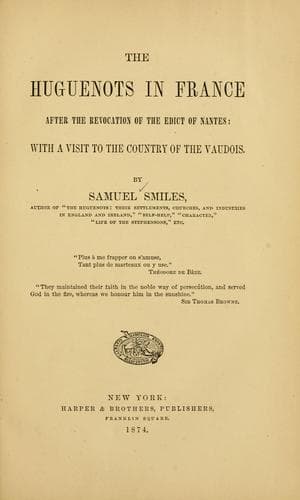
Dauphiné (France) -- Description and travel; Huguenots; Waldenses
He resided there, however, only about four months. Saint-Ruth and De
Noailles were now overawing Upper Languedoc with their troops. The
Protestants of Nismes had taken no part in "The Project;" their
remaining temple was still open. But they got up a respectful petition
to the King, imploring his consideration of their case. Roman
Catholics and Protestants, they said, had so many interests in common,
that the ruin of the one must have the effect of ruining the
other,--the flourishing manufactures of the province, which were
mostly followed by the Protestants, being now rapidly proceeding to
ruin. They, therefore, implored his Majesty to grant them permission
to prosecute their employments unmolested on account of their
religious profession; and lastly, they conjured the King, by his
piety, by his paternal clemency, and by every law of equity, to grant
them freedom of religious worship.
It was of no use. The hearts of the King, his clergy, and his
ministers, were all hardened against them. A copy of the above
petition was presented by two ministers of Nismes and several
influential gentlemen of Lower Languedoc to the Duke de Noailles, the
governor of the province. He treated the deputation with contempt, and
their petition with scorn. Writing to Louvois, the King's prime
minister, De Noailles said: "Astonished at the effrontery of these
wretched persons, I did not hesitate to send them all prisoners to the
Citadel of St. Esprit (in the Cevennes), telling them that if there
had been _petites maisons_[25] enough in Languedoc I should not have
sent them there."
[Footnote 25: The prisons of Languedoc were already crowded
with Protestants, and hundreds had been sent to the galleys
at Marseilles.]
Nismes was now placed under the same ban as Vivarais, and denounced as
"insurrectionary." To quell the pretended revolt, as well as to
capture certain persons who were supposed to have been accessory to
the framing of the petition, a detachment of four hundred dragoons was
ordered into the place. One of those to be apprehended was Claude
Brousson. Hundreds of persons knew of his abode in the city, but
notwithstanding the public proclamation (which he himself heard from
the window of the house where he was staying), and the reward offered
for his apprehension, no one attempted to betray him.
After remaining in the city for three days, he adopted a disguised
dress, passed out of the Crown Gate, and in the course of a few days
found a safe retreat in Switzerland.
Public-domain text, read in full here on John Shaqi.
Reviews
Reviews
No reviews yet
Be the first to share your thoughts on this work.
Join the Discussion
Join the discussion
Sign in to leave a comment or review.
Sign InorCreate an account