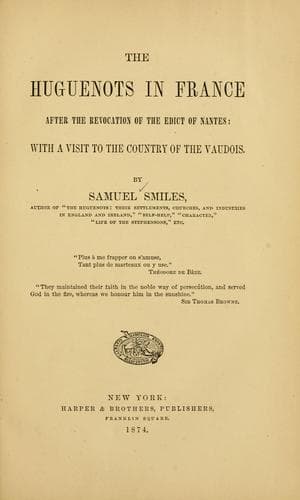
Dauphiné (France) -- Description and travel; Huguenots; Waldenses
[Footnote 37: Whether it be that Calvinism is eclectic as
regards races and individuals, or that it has (as is most
probably the case) a powerful formative influence upon
individual character, certain it is that the Calvinists of
all countries have presented the strongest possible
resemblance to each other--the Calvinists of Geneva and
Holland, the Huguenots of France, the Covenanters of
Scotland, and the Puritans of Old and New England, seeming,
as it were, to be but members of the same family. It is
curious to speculate on the influence which the religion of
Calvin--himself a Frenchman--might have exercised on the
history of France, as well as on the individual character of
Frenchmen, had the balance of forces carried the nation
bodily over to Protestantism (as was very nearly the case)
towards the end of the sixteenth century. Heinrich Heine has
expressed the opinion that the western races contain a large
proportion of men for whom the moral principle of Judaism has
a strong elective affinity; and in the sixteenth and
seventeenth centuries, the Old Testament certainly seems to
have exercised a much more powerful influence on the minds of
religious reformers than the New. "The Jews," says Heine,
"were the Germans of the East, and nowadays the Protestants
in German countries (England, Scotland, America, Germany,
Holland) are nothing more nor less than ancient Oriental
Jews."]
The French Calvinist peasantry, like the Scotch, were great in their
preachers and their prophets. Both devoted themselves with enthusiasm
to psalmody, insomuch that "psalm-singers" was their nickname in both
countries. The one had their Clement Marot by heart, the other their
Sternhold and Hopkins. Huguenot prisoners in chains sang psalms in
their dungeons, galley slaves sang them as they plied at the oar,
fugitives in the halting-places of their flight, the condemned as they
marched to the gallows, and the Camisards as they rushed into battle.
It was said of the Covenanters that "they lived praying and preaching,
and they died praying and fighting;" and the same might have been said
of the Huguenot peasantry of the Cevennes.
Public-domain text, read in full here on John Shaqi.
Reviews
Reviews
No reviews yet
Be the first to share your thoughts on this work.
Elsewhere in the archive
Join the Discussion
Join the discussion
Sign in to leave a comment or review.
Sign InorCreate an account