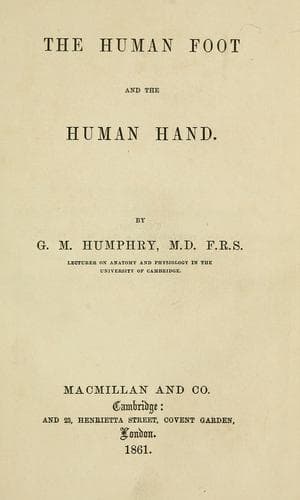
The human foot and the human handHumphry, George Murray, Sir
Science
The human foot and the human hand
Humphry, George Murray, Sir
Foot; Hand
It is one of the master results of creation, and one of the peculiar
marks of creative genius, that _perfection_ and _beauty_ are usually
presented together. As truth is the soul of eloquence, so is perfection
the soul of beauty. The works of nature are beautiful because there is
so much excellence in them, such admirable adaptation to their purpose;
and we find the works of man beautiful only so far as they are correct
imitations of their great originals in nature, or show some approach
to nature’s excellence. And man is the most beautiful object in nature
because he is the most perfect, that is, because the purpose of his
existence is the highest, and because his physique exhibits the most
marvellous moulding to adapt it to its high purpose; because, in short,
in him the material is wrought to such a point of refinement as to be
the receptacle and minister of the immaterial.
The movements of the three joints between the foot and the leg take
place in harmony. The following is the order observed. The raising
of the _heel_ is accompanied by a rolling of the foot _in_wards, and
by an increased _flexure_ of the plantar arch; and the raising of
the _toes_ is accompanied by a rolling of the foot _out_wards and a
_straightening_ of the sole.
_The Muscles of the Leg and Foot._
[Illustration: Fig. 12.]
The _first_ series of the movements just described is effected,
mainly, by three muscles. Of these one (A, fig. 12) raises the
heel while the other two (B, fig. 12, and C, fig. 13) raise
and support the ankle. The muscle which acts upon the heel is one of
the largest and most powerful in the body; and well it may be, for in
raising the heel it has to raise the whole weight of the body. Its
fibres, accumulated at the middle and upper part of the leg, form the
“calf;” below they taper into a thick tendon (a) connected with the
hinder extremity of the heel-bone, and called the _Tendo Achillis_. The
name, it need scarcely be said, refers to the tale of Thetis holding
her son Achilles by this part when she dipped him in the river Styx.
Her hand prevented the part from coming in contact with the water; and
so it did not partake of the invulnerability which was conferred upon
the rest of his body by the immersion. We read, accordingly, he was
finally killed by a wound in the heel[2].
Public-domain text, read in full here on John Shaqi.
Reviews
Reviews
No reviews yet
Be the first to share your thoughts on this work.
Join the Discussion
Join the discussion
Sign in to leave a comment or review.
Sign InorCreate an account