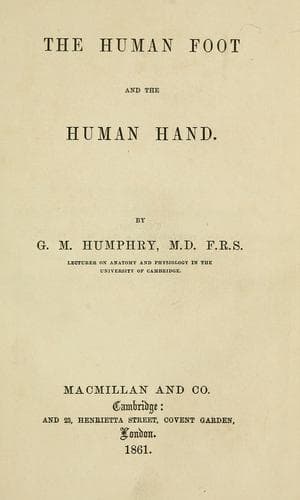
The human foot and the human handHumphry, George Murray, Sir
Science
The human foot and the human hand
Humphry, George Murray, Sir
Foot; Hand
Another has a halting, shuffling, undecided gait; while a third walks
in a bold, determined, straight-forward, erect and independent manner.
One has a cautious, parsimonious step, as if sparing of shoe-leather,
or afraid to trust the ground; he has, however, probably, trusted the
funds with considerable investments. Some walk with long, pretentious,
measured strides; others make short, quick, insignificant steps. Some,
again, are hurried, fussy, noisy; while others glide along in a quiet,
shrinking, unpretending, it may be timid, manner.
I need not dilate upon these diversities. Your own observation will
supply abundant illustrations of the correspondence between character
and manner of walking.
The several movements in walking are under the control of the WILL,
and are directed by it, to such an extent that the continuous agency
of the will is essential to the process. If the influence of the will
be suspended, but for a moment, the action ceases, and the man falls
to the ground. Nevertheless, the play of the individual muscles, and
their co-ordination, or the manner in which their several movements
are combined, are, in a great measure, independent of the will.
They are, to a certain extent, automatic, and result from peculiar
relations between the nervous and the muscular systems. The will may
be compared to the driver of an engine, who, by turning on the steam,
and maintaining the supply, sets the machine in motion, and regulates
the rate of its speed; but the several wheels are so arranged that they
go on irrespectively of his immediate superintendence. It would be
impossible for the engine-man to attend to the working of each detail
of his machine; and it would be too much for the will to have to direct
all the movements of the limbs in walking. We should be wearied with
such an effort of attention before we had walked across a room; for the
exercise of the will is exhausting, and soon engenders fatigue. The
more we think of any movement and take pains to direct it, the sooner
we are tired and unable to continue it; and the more the attention is
diverted, the less quickly do we experience a feeling of exhaustion;
while those movements in the body which are not at all under the
influence of the will--the movements of the heart for instance--go on
unceasingly, through a long life, without any sense of weariness. What
so prevents fatigue, when we are walking, as the diverting conversation
of an agreeable companion?
Public-domain text, read in full here on John Shaqi.
Reviews
Reviews
No reviews yet
Be the first to share your thoughts on this work.
Join the Discussion
Join the discussion
Sign in to leave a comment or review.
Sign InorCreate an account