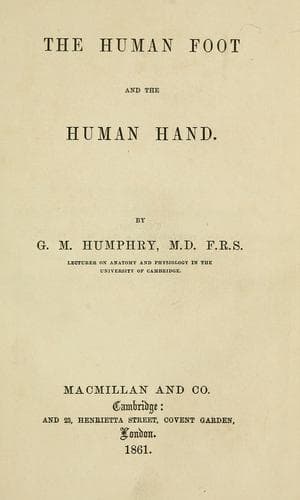
The human foot and the human handHumphry, George Murray, Sir
Science
The human foot and the human hand
Humphry, George Murray, Sir
Foot; Hand
How important is the sense of Feeling! more important than any of
the other senses; more so than all the others taken together. It
is almost universal in the animal kingdom. Indeed, we can scarcely
conceive animal existence without it, and are slow to admit that to be
an animal which shows no sign of it. Several of the lower animals seem
to be destitute of any of the other senses. The POLYPS, for instance,
have no sight, hearing, taste, or smell, and are dependent, therefore,
entirely, upon feeling for their communication with the external world;
and the range of this sense is extended in them by means of their
“tentacles” or “feelers” which wave about in the water, and, when they
come in contact with foreign bodies, close upon them and draw them
towards the oral opening. Thus, the tentacle of the polyp is a sort of
rudimentary hand, and, by the aid of feeling, fulfils one important
function of the hand, viz. that of the supplying the mouth with food.
The sprawling movements of an infant’s hands and the tendency which
they have to close upon anything--dress, blanket, or whatever it
be--and draw it to the mouth remind one forcibly of the feelers of a
polyp.
In most of the lower animals, however, the sense of feeling, though
present, serving for protection and giving notice of injury, is
not very acute. It is not much employed by them for the purpose of
obtaining information respecting external objects; and they can
scarcely be said to enjoy that modification of it which we call the
sense of touch in any high degree. Indeed, the skins of animals have,
commonly, such a covering of thick, horny cuticle, scales, feathers, or
hair, as is incompatible with a fine discriminating sense of touch.
In many of them, however, some other sense is highly developed. The
VULTURE is guided by the smell of carrion for miles and miles; and
the dog will, by the same sense, track game where man cannot detect
the trace of an odour. Some birds can distinguish objects which are
quite out of the range of our sight. The EAGLE, for instance, soars
aloft, till it dwindles to a mere speck or is lost to our view, and,
then, from that great height, will pounce, with unerring certainty,
on an unhappy grouse upon the ground. The sense of hearing is a great
means of protection to animals, and necessitates extreme stillness and
caution on the part of their pursuers. The DEER, when feeding, directs
his eyes upon the ground, and depends for safety, chiefly, upon his
hearing, which is so acute that the huntsman is obliged to approach
with all possible wariness.
Public-domain text, read in full here on John Shaqi.
Reviews
Reviews
No reviews yet
Be the first to share your thoughts on this work.
Elsewhere in the archive
Join the Discussion
Join the discussion
Sign in to leave a comment or review.
Sign InorCreate an account