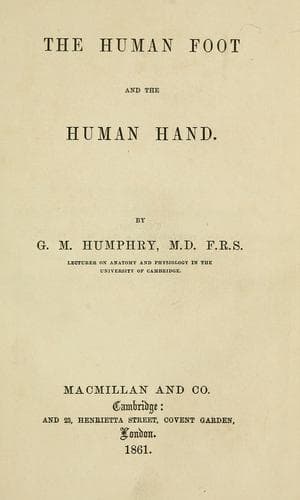
The human foot and the human handHumphry, George Murray, Sir
Science
The human foot and the human hand
Humphry, George Murray, Sir
Foot; Hand
In each of these instances, it may be observed, the acuteness of the
particular sense is manifested chiefly in the power it gives to the
animal of distinguishing objects _at a distance_. Whereas, in the
ability to use the several senses for the nice discernment of the
_qualities_ of substances and to derive enjoyment from them, man stands
quite unrivalled. He alone appreciates the perfume of a bouquet, or
takes cognisance of the various shades of colour and of the notes of
music; and the sense of touch, which is of especial service in aiding
us to an accurate knowledge of bodies, is much more highly developed in
man than in other animals.
Fine as the sense of touch usually is in the human hand, it becomes
far more so when an unusual demand is made upon it in consequence of a
deficiency, or absence, of other senses. The rapidity with which blind
persons can read with their fingers is truly astonishing. Some are
said to be able to distinguish colours by the feel. (It should rather
be said that they are capable of recognising the nice differences in
certain substances by which colours are caused; for one can scarcely
conceive it possible to distinguish by feeling the colours in a ray of
light separated by a prism.) I am acquainted with a lady who has been,
not only blind, but deaf and dumb from infancy. The sense of touch is,
therefore, almost her only avenue for impressions from without; and
it is surprising how much information is conveyed through it, and how
quickly. It enables her to hold converse with her relatives, by the
language of the fingers, almost as freely and as briskly as others do
with the tongue. A few touches are sufficient to transmit a series of
thoughts. After one shake of the hand her friends told me that she
would recognise me again; and, true enough, although several days
elapsed before I again saw her, she made the sign for my name as soon
as she touched my hand. At our next meeting I presented my left hand,
but was, again, immediately recognised.
Persons who have had much experience in the instruction of the deaf
and dumb find that the hand, by means of writing and “dactylogy”, or
the language of finger-signs, is abundantly sufficient for all the
intercourse to which a deaf-mute is equal; and they are, therefore,
disposed to discourage the teaching of articulation. Dr Kitto, in his
little book “On the Lost Senses,” which acquires so much interest
from the fact of his being himself deaf and dumb in consequence of an
accident, relates that, after he had, with great difficulty, reacquired
considerable facility of speech, he found it stood him in little stead.
So efficient a means of intercourse had the hand become that, he tells
us, he had not occasion for the use of his tongue ten times in a year.
Public-domain text, read in full here on John Shaqi.
Reviews
Reviews
No reviews yet
Be the first to share your thoughts on this work.
Elsewhere in the archive
Join the Discussion
Join the discussion
Sign in to leave a comment or review.
Sign InorCreate an account