The Human Interest: A Study in IncompatibilitiesHunt, Violet
General
The Human Interest: A Study in Incompatibilities
Hunt, Violet
Man-woman relationships -- Fiction; Women -- England -- Fiction
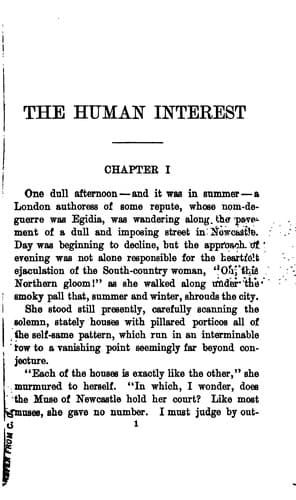
“But then, you know, I have never seen your husband,” Egidia was saying
to the pretty little woman who, sunk deep in the billowy mound of a very
easy chair, her feet upheld to the glow of a North-country fire blazing
away in the very height of summer, as usual, was expatiating in the
sweetest of voices on her matrimonial unhappiness. She was telling
Egidia all the truth, or thought she was, and the novelist, in her
double capacity of friend and gatherer of welcome “copy,” was listening
sympathetically from her sofa.
It was a charming house in the suburbs of Newcastle, the abode of
charming people, where Egidia was staying, and Mrs. Elles deeply
appreciated the friendship with the fashionable lecturer, which had
gained her the entry into this home of modernity and culture.
“Yes, if you once saw Mortimer,” Mrs. Elles went on, “you would
understand all!”
The way she uttered the last word would not have disgraced a tragic
actress.
“I want you to come and dine--will you? What day shall it be? Tell me,
and I’ll fix it. Then you will see him, and judge for yourself.”
“My dear,” said the novelist, slowly, “I will come to your dinner with
pleasure, but I shall not know any more than you have told me.”
“Yes; I have been very, very frank,” said Mrs. Elles. “And there is
another thing”--she sighed vaguely. She was alluding to her husband’s
habit of tippling, to which as a loyal wife she forbore from a more
direct allusion.
“As a general rule,” Egidia went on, a little didactically, in her
capacity of mentor, “no husband understands any wife. If he did, he
wouldn’t have cared to marry her. It is the mutual antagonism between
the sexes which makes them interesting to each other in the beginning.
But, afterwards--if they are unable to play the game--exciting enough, I
should think--of observing, of adjusting, of utilizing their mutual
divergences of character and getting amusement out of them--if she finds
no pleasure in the exercise of tact, if he none in the further analysis
of the feminine vagaries that he began by finding so charming--then,
they begin to jar mutually on each other, and turn that into tragedy
which should be the comedy of life for both of them.”
“I understand,” said Mrs. Elles, humbly; “but then--there is not, and
could not be, any comedy of life with Mortimer, or tragedy either! There
never was. I don’t seem to care to appreciate his character, I know
it--it is quite simple--I see it all spread out before me like a map--of
a country I don’t care to travel over.”
“But perhaps he can say the same of you,” hazarded Egidia.
“No, Mortimer has never understood me, never! I am a sealed book to
him,” said the wife, airily, although Miss Giles’ suggestion had indeed
given her a little shock.
“Don’t flatter yourself, my dear, that you are a sealed book to anyone.
It is the common delusion.” (Another shock to Mrs. Elles!) “One is
always so much less interesting, so much less complicated, so much less
of a sphinx than one thinks.”
Public-domain text, read in full here on John Shaqi.
Reviews
Reviews
No reviews yet
Be the first to share your thoughts on this work.
Join the Discussion
Join the discussion
Sign in to leave a comment or review.
Sign InorCreate an account