The Human Interest: A Study in IncompatibilitiesHunt, Violet
General
The Human Interest: A Study in Incompatibilities
Hunt, Violet
Man-woman relationships -- Fiction; Women -- England -- Fiction
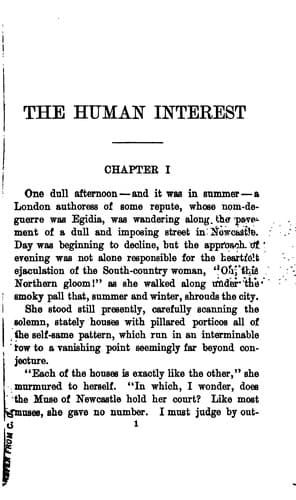
“Muslin curtains are a mistake in an atmosphere like this of Newcastle!”
she thought, “and a parlour-maid should not aim at looking like Madame
Sans Gêne.”
She was shown into a drawing-room, “stamped with the evidences of
culture,” as the interviewer would say, and “redolent of a personality.”
Books were scattered about; the piano stood open, with the latest
“mood” of the latest fashionable composer lying on it; there were
magazines, with paper-knives negligently bisecting their leaves. There
were, on the walls, some grim old pictures--family portraits,
presumably--of ill-tempered, high-stocked old gentlemen and prim,
dignified ladies, but they were interspersed with sundry scratchy and
erratic modern etchings and photogravures; there were great bowls of
flowers--whose apparent substance, the authoress could not help
suspecting, was cleverly eked out with artificial imitations procurable
at drapers’ shops. The whole effect was rather pretty and French, and
thoroughly out of keeping with the grim realities of Northern hardness
and abnegation of art-feeling that reigned outside.
A young woman, beautifully dressed, who was sitting over the fire,
though it was not cold, rose eagerly to receive her distinguished guest,
exclaiming, with the most flattering and heart-felt emphasis,
“Oh, Miss Giles, how good of you to come! I was afraid you would have
quite forgotten me and my day!”
She was a slight woman, not tall, but slender enough to look so. Her
eyes were very large and bright, her cheeks, flushed, perhaps with the
fire. She made wrinkles when she laughed, but she did not look more than
twenty-eight. A little powder, carelessly and innocently cast there,
showed on cheeks “hollowed a little mournfully,” as the poet has it. Her
hair was arranged in hundreds of little waves and curls, and her
dress--Egidia had been in the best houses in Newcastle, during the last
few days, but had seen nothing to equal the style and taste of this
little solicitor’s wife. Thought and ingenuity had gone to the devising
of that gown, but the wearer of it had forgotten to fasten the last two
buttons of her sleeve.
“The artistic sense strongly developed--but very little power of
co-ordination.” So the authoress, taking all these points into
consideration and exercising her own professional faculty of
classification, mentally assessed her hostess.
“This is my day,” Mrs. Elles was assuring her. “I partly hope people
will come, and partly not. I would so much rather have you to
myself--but then, some of my friends were so anxious to meet you when I
said I knew you--so I had to give them a chance--you don’t mind being
lionized a little, do you? We can’t help it!”
Public-domain text, read in full here on John Shaqi.
Reviews
Reviews
No reviews yet
Be the first to share your thoughts on this work.
Join the Discussion
Join the discussion
Sign in to leave a comment or review.
Sign InorCreate an account