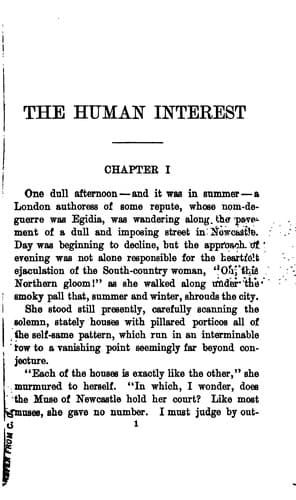
The Human Interest: A Study in IncompatibilitiesHunt, Violet
General
The Human Interest: A Study in Incompatibilities
Hunt, Violet
Man-woman relationships -- Fiction; Women -- England -- Fiction
She realized his want of sympathy and humanity, his elaborate attitude
of standing aside from the problems of life in favour of a closer
contemplation of those of Nature. It was Nature he loved, and Nature
only, with his full heart. The human interest was a purely secondary
consideration with him. Not “in many mortal forms” did he seek “the
shadow of that idol.” He was Alastor and she was the Lady. She must
remember that. Alastor could doubtless have done quite well without the
Lady. She represented the ever-restless Spirit of Humanity which Alastor
had come into the wilderness to avoid. And, for his sake, for the sake
of her valued privileges, she must learn to keep it in abeyance and
suppress it as far as she could. She must love Nature too. It was
difficult, for though, in her quality of romanticist, she had always
talked a good deal about it. Nature, to her, was merely a background for
people, just as flowers were an adornment for her bodice or her parlour.
But the very conditions of her tenure here demanded that she should
accommodate herself to the mood of her companion. Since, by happy
chance, she was admitted to be an inmate with him of the terrestrial
Paradise of which he was the tutelary God, she must contrive, as animals
do, to adapt herself to her new habitat. She thought of herself as a
tremulous, storm-tossed soul, newly entered into bliss, and afraid to
compromise her precarious happiness by any assumption of right or too
marked a signalizing of her presence there.
With this end in view, she began to cultivate a capacity for silence, an
art of self-effacement, a spirit-like vagueness of outline. Her wish was
to dissimulate her personality as far as was possible, and merely to
form, as it were, part of the silent, unobtrusive world of Nature that
he loved. It was a stiff novitiate to a complete education.
Her plan was successful, on the whole. The painter began to take her as
a matter of course, to treat her as if she had always been there, as a
busy man might treat a sister, or a college companion, without ceremony,
but with much protective kindness and camaraderie. She was sure that the
notion of her being in any way compromised by her stay with him in this
lonely inn never so much as entered his mind. It was not that he was
ignorant of conventions; he was simply too preoccupied to think of them.
But, indeed, the new brightness of her eyes, bred of her happiness, the
lovely, natural colour in her cheeks, the conscious curve of her red
lips, inevitably suggested the world’s cry for a chaperon. She had been
an interesting woman when she came to Rokeby; she was now almost a
beautiful one. The little hollows in her cheeks had filled up; her
figure had improved; she was like a blue serge wood nymph darting about
the broken pathways and shelving banks of this embowered painter’s
paradise.
Public-domain text, read in full here on John Shaqi.
Reviews
Reviews
No reviews yet
Be the first to share your thoughts on this work.
Join the Discussion
Join the discussion
Sign in to leave a comment or review.
Sign InorCreate an account