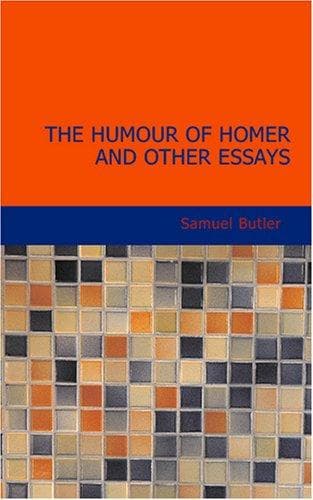
The Humour of Homer and Other EssaysButler, Samuel
History
The Humour of Homer and Other Essays
Butler, Samuel
Essays; Greek wit and humor -- History and criticism; Homer -- Humor
Here we have touched on the second essential element of language.
We laid it down, that its essence lay in the communication of an
idea from one intelligent being to another; but no ideas can be
communicated at all except by the aid of conventions to which both
parties have agreed to attach an identical meaning. The agreement
may be very informal, and may pass so unconsciously from one
generation to another that its existence can only be recognized by
the aid of much introspection, but it will be always there. A
sayer, a sayee, and a convention, no matter what, agreed upon
between them as inseparably attached to the idea which it is
intended to convey--these comprise all the essentials of language.
Where these are present there is language; where any of them are
wanting there is no language. It is not necessary for the sayee to
be able to speak and become a sayer. If he comprehends the sayer--
that is to say, if he attaches the same meaning to a certain symbol
as the sayer does--if he is a party to the bargain whereby it is
agreed upon by both that any given symbol shall be attached
invariably to a certain idea, so that in virtue of the principle of
associated ideas the symbol shall never be present without
immediately carrying the idea along with it, then all the essentials
of language are complied with, and there has been true speech though
never a word was spoken.
The lower animals, therefore, many of them, possess a part of our
own language, though they cannot speak it, and hence do not possess
it so fully as we do. They cannot say "bread," "meat," or "water,"
but there are many that readily learn what ideas they ought to
attach to these symbols when they are presented to them. It is idle
to say that a cat does not know what the cat's-meat man means when
he says "meat." The cat knows just as well, neither better nor
worse than the cat's-meat man does, and a great deal better than I
myself understand much that is said by some very clever people at
Oxford or Cambridge. There is more true employment of language,
more bona fide currency of speech, between a sayer and a sayee who
understand each other, though neither of them can speak a word, than
between a sayer who can speak with the tongues of men and of angels
without being clear about his own meaning, and a sayee who can
himself utter the same words, but who is only in imperfect agreement
with the sayer as to the ideas which the words or symbols that he
utters are intended to convey. The nature of the symbols counts for
nothing; the gist of the matter is in the perfect harmony between
sayer and sayee as to the significance that is to be associated with
them.
Public-domain text, read in full here on John Shaqi.
Reviews
Reviews
No reviews yet
Be the first to share your thoughts on this work.
Elsewhere in the archive
Join the Discussion
Join the discussion
Sign in to leave a comment or review.
Sign InorCreate an account