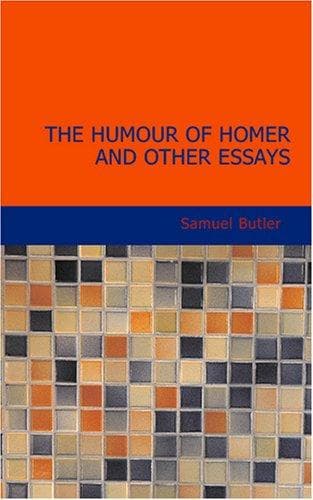
The Humour of Homer and Other EssaysButler, Samuel
History
The Humour of Homer and Other Essays
Butler, Samuel
Essays; Greek wit and humor -- History and criticism; Homer -- Humor
Professor Max Muller admits that we share with the lower animals
what he calls an emotional language, and continues that we may call
their interjections and imitations language if we like, as we speak
of the language of the eyes or the eloquence of mute nature, but he
warns us against mistaking metaphor for fact. It is indeed mere
metaphor to talk of the eloquence of mute nature, or the language of
winds and waves. There is no intercommunion of mind with mind by
means of a covenanted symbol; but it is only an apparent, not a
real, metaphor to say that two pairs of eyes have spoken when they
have signalled to one another something which they both understand.
A schoolboy at home for the holidays wants another plate of pudding,
and does not like to apply officially for more. He catches the
servant's eye and looks at the pudding; the servant understands,
takes his plate without a word, and gets him some. Is it metaphor
to say that the boy asked the servant to do this, or is it not
rather pedantry to insist on the letter of a bond and deny its
spirit, by denying that language passed, on the ground that the
symbols covenanted upon and assented to by both were uttered and
received by eyes and not by mouth and ears? When the lady drank to
the gentleman only with her eyes, and he pledged with his, was there
no conversation because there was neither noun nor verb? Eyes are
verbs, and glasses of wine are good nouns enough as between those
who understand one another. Whether the ideas underlying them are
expressed and conveyed by eyeage or by tonguage is a detail that
matters nothing.
Public-domain text, read in full here on John Shaqi.
Reviews
Reviews
No reviews yet
Be the first to share your thoughts on this work.
Elsewhere in the archive
Join the Discussion
Join the discussion
Sign in to leave a comment or review.
Sign InorCreate an account