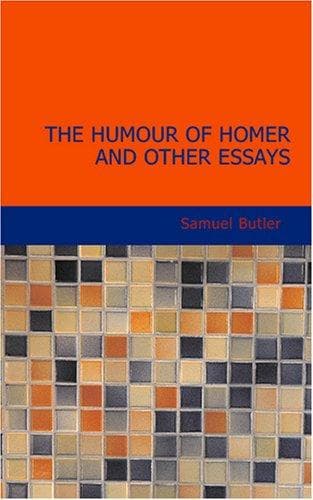
The Humour of Homer and Other EssaysButler, Samuel
History
The Humour of Homer and Other Essays
Butler, Samuel
Essays; Greek wit and humor -- History and criticism; Homer -- Humor
Who, then, are the most likely so to run that they may obtain this
veritable prize of our high calling? Setting aside such lucky
numbers, drawn as it were in the lottery of immortality, which I
have referred to casually above, and setting aside also the chances
and changes from which even immortality is not exempt, who on the
whole are most likely to live anew in the affectionate thoughts of
those who never so much as saw them in the flesh, and know not even
their names? There is a nisus, a straining in the dull dumb economy
of things, in virtue of which some, whether they will it and know it
or no, are more likely to live after death than others, and who are
these? Those who aimed at it as by some great thing that they would
do to make them famous? Those who have lived most in themselves and
for themselves, or those who have been most ensouled consciously,
but perhaps better unconsciously, directly but more often
indirectly, by the most living souls past and present that have
flitted near them? Can we think of a man or woman who grips us
firmly, at the thought of whom we kindle when we are alone in our
honest daw's plumes, with none to admire or shrug his shoulders, can
we think of one such, the secret of whose power does not lie in the
charm of his or her personality--that is to say, in the wideness of
his or her sympathy with, and therefore life in and communion with
other people? In the wreckage that comes ashore from the sea of
time there is much tinsel stuff that we must preserve and study if
we would know our own times and people; granted that many a dead
charlatan lives long and enters largely and necessarily into our own
lives; we use them and throw them away when we have done with them.
I do not speak of these, I do not speak of the Virgils and Alexander
Popes, and who can say how many more whose names I dare not mention
for fear of offending. They are as stuffed birds or beasts in a
museum; serviceable no doubt from a scientific standpoint, but with
no vivid or vivifying hold upon us. They seem to be alive, but are
not. I am speaking of those who do actually live in us, and move us
to higher achievements though they be long dead, whose life thrusts
out our own and overrides it. I speak of those who draw us ever
more towards them from youth to age, and to think of whom is to feel
at once that we are in the hands of those we love, and whom we would
most wish to resemble. What is the secret of the hold that these
people have upon us? Is it not that while, conventionally speaking,
alive, they most merged their lives in, and were in fullest
communion with those among whom they lived? They found their lives
in losing them. We never love the memory of anyone unless we feel
that he or she was himself or herself a lover.
Public-domain text, read in full here on John Shaqi.
Reviews
Reviews
No reviews yet
Be the first to share your thoughts on this work.
Elsewhere in the archive
Join the Discussion
Join the discussion
Sign in to leave a comment or review.
Sign InorCreate an account