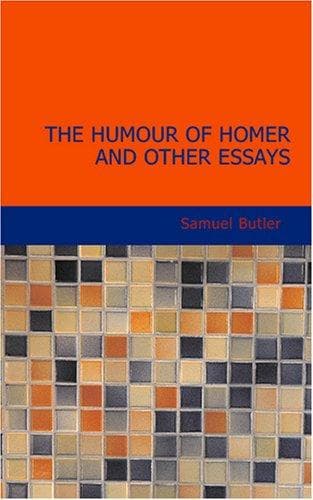
The Humour of Homer and Other EssaysButler, Samuel
History
The Humour of Homer and Other Essays
Butler, Samuel
Essays; Greek wit and humor -- History and criticism; Homer -- Humor
I have seen it urged, again, in querulous accents, that the so-
called immortality even of the most immortal is not for ever. I see
a passage to this effect in a book that is making a stir as I write.
I will quote it. The writer says:--
"So, it seems to me, is the immortality we so glibly predicate of
departed artists. If they survive at all, it is but a shadowy
life they live, moving on through the gradations of slow decay to
distant but inevitable death. They can no longer, as heretofore,
speak directly to the hearts of their fellow-men, evoking their
tears or laughter, and all the pleasures, be they sad or merry,
of which imagination holds the secret. Driven from the market-
place they become first the companions of the student, then the
victims of the specialist. He who would still hold familiar
intercourse with them must train himself to penetrate the veil
which in ever-thickening folds conceals them from the ordinary
gaze; he must catch the tone of a vanished society, he must move
in a circle of alien associations, he must think in a language
not his own." {150}
This is crying for the moon, or rather pretending to cry for it, for
the writer is obviously insincere. I see the Saturday Review says
the passage I have just quoted "reaches almost to poetry," and
indeed I find many blank verses in it, some of them very aggressive.
No prose is free from an occasional blank verse, and a good writer
will not go hunting over his work to rout them out, but nine or ten
in little more than as many lines is indeed reaching too near to
poetry for good prose. This, however, is a trifle, and might pass
if the tone of the writer was not so obviously that of cheap
pessimism. I know not which is cheapest, pessimism or optimism.
One forces lights, the other darks; both are equally untrue to good
art, and equally sure of their effect with the groundlings. The one
extenuates, the other sets down in malice. The first is the more
amiable lie, but both are lies, and are known to be so by those who
utter them. Talk about catching the tone of a vanished society to
understand Rembrandt or Giovanni Bellini! It is nonsense--the folds
do not thicken in front of these men; we understand them as well as
those among whom they went about in the flesh, and perhaps better.
Homer and Shakespeare speak to us probably far more effectually than
they did to the men of their own time, and most likely we have them
at their best. I cannot think that Shakespeare talked better than
we hear him now in Hamlet or Henry the Fourth; like enough he would
have been found a very disappointing person in a drawing-room.
People stamp themselves on their work; if they have not done so they
are naught, if they have we have them; and for the most part they
stamp themselves deeper on their work than on their talk. No doubt
Shakespeare and Handel will be one day clean forgotten, as though
they had never been born. The world will in the end die; mortality
Public-domain text, read in full here on John Shaqi.
Reviews
Reviews
No reviews yet
Be the first to share your thoughts on this work.
Elsewhere in the archive
Join the Discussion
Join the discussion
Sign in to leave a comment or review.
Sign InorCreate an account