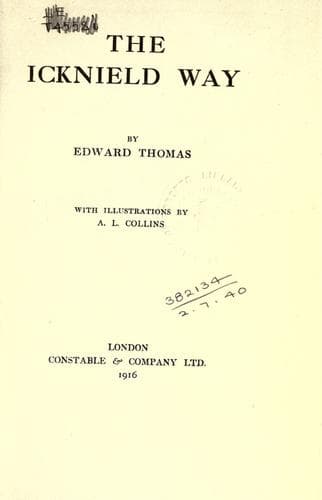
England -- Description and travel; Icknield Way (England); Thomas, Edward, 1878-1917
night-dress was dry as it had ever been in the linen cupboard at her
stately home; and her hair, though loose, was not untidy and would have
pleased a lover, had she confessed one and had he, instead of another
lady, been aiding her in distress. I had last seen these two pictures
at Tregaron, and I sighed with a serene and pleasant recollection of
the place, the season, and the company.
I was glad also to see a third work of the same artist, or at least of
the same school. It belonged to a different period, geological rather
than marine; and again it must be insisted that the work was visionary
because no one capable of a mere invention so ridiculous is likely to
have the power and the patience to execute it with such completeness
and finish. The scene was midnight in a valley of rocks and of high,
precipitous, rocky sides, wide enough apart to have admitted a mountain
torrent of some size. But it was dry, and over the sharp rocks went
a most beautiful lady. She was dressed in thin and clinging garments
from her shoulders down to her ankles. To meet a woman so beautiful
and so suitably and yet unusually dressed all alone in the mountains
would be at least as surprising as to see her on a little rock in the
sea as one was passing in a storm. I could imagine her easily upon the
velvet-covered rock. Her arms were bare, and with one she clasped a
book to her left breast, while with the other she felt her way along
the precipitous wall of the valley and steadied herself over the cruel
rocks. It was to be noticed that there was no velvet over these rocks,
and this is another proof of the genuineness of the artist’s vision,
unless it should be suspected that he disliked the appearance of a long
strip of carpet all down a valley. A fierce and extravagant vision,
you will say. But the gentleness which had somehow ensured the carpet
in the marine vision had not been eclipsed in the geological. From
the edge of the farther wall of the valley shone a light. Someone was
up there with a lantern and was turning its beams down on to the spot
under the fair traveller’s feet. There could be little doubt that he
was following her along with the light, but he could not be seen. The
lantern would have been more _natural_ in a narrow alley in a town,
but there was no question here of mere nature. If it comes to nature,
was there ever a period when a woman of such beauty, and of very great
refinement, strayed out with a book among inhospitable mountains,
clad in a dress that was fitted rather to suggest and even display
the form of limbs and bosom than to protect them from rocks, thorns,
and weather, not to speak of men and other wild beasts? A voluptuous
Oriental or Frenchman might of course sit down and invent an earthly
paradise with a small population of like beauties, but their object
would be as unmistakable as it would be objectionable to persons of
sensibility and discipline, except when alone or off their guard. But
Public-domain text, read in full here on John Shaqi.
Reviews
Reviews
No reviews yet
Be the first to share your thoughts on this work.
Elsewhere in the archive
Join the Discussion
Join the discussion
Sign in to leave a comment or review.
Sign InorCreate an account