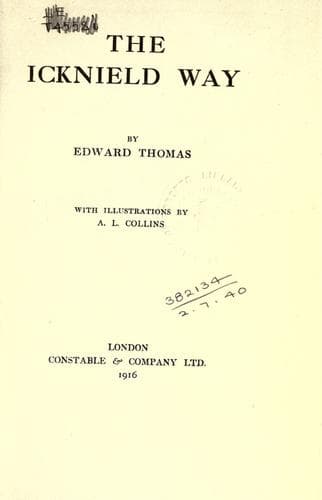
England -- Description and travel; Icknield Way (England); Thomas, Edward, 1878-1917
But round the corner, towards the common, “The Jolly Drover” is
white no longer. It has no pavement outside, but a space of bare
earth overshadowed by an enormous elm’s last two living branches and
roughened by its wide-spreading roots. There is no invitation to enter
here, but simply the words upon a low lamp, “The Jolly Drover Tap.”
No invitation is needed, for the windows are not curtained and the
passer-by cannot fail to see the contented backs of drinkers and the
long tiers of bottles. At night almost as much can be seen through the
yellow blinds. The door stands open opposite the old tree, and through
it the eye finds the bar, the plain country barmaid, the lamp, and the
bright bottles. A mongrel dog or two and a gypsy’s broken-down cart and
wild-eyed horse are usually outside, or a tramp’s woman waiting, or a
group of men talking quietly before going in or after coming out. Here
“The Jolly Drover” answers to its name. It is a hedge public house of
old red brick and tiles, joined, nevertheless, to the white-fronted
hotel and connected with it in the proprietor’s accounts. It is noisy.
They sing there. No plain man is afraid to go in who has the price of
half a pint in his pocket. In the summer benches are set outside, and
men can sit and see the discreet going to and fro of the town life a
few yards away.
Old Jack Runaway (who will borrow sixpence and then lose half a year’s
custom in watercress for fear of showing his face again) has lost six
heifers that he was taking to the fair over the hill, but he has a pint
inside and a pint before him--the clock stands still--and as the people
go by he comments to himself:--
Public-domain text, read in full here on John Shaqi.
Reviews
Reviews
No reviews yet
Be the first to share your thoughts on this work.
Elsewhere in the archive
Join the Discussion
Join the discussion
Sign in to leave a comment or review.
Sign InorCreate an account