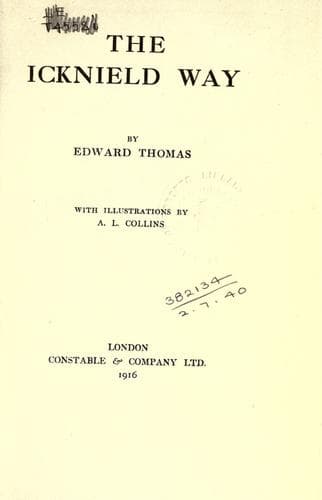
England -- Description and travel; Icknield Way (England); Thomas, Edward, 1878-1917
They were talking about roads at the “Morning Star” on the left side of
the “Papist Way.” The fat drayman and the smart butcher’s boy agreed
that motor-cars were ruining the good roads. The rubber wheels can
travel on the smoothest possible surface, which is the modern ideal.
Hoofs, on the other hand, need something to bite into. The drayman,
with his heavy waggon, would do away with steam-rollers. Here the needy
cyclist interrupted, and said that he had never known better times; the
smooth roads were as good for him as for motor-cars. All cursed their
dust, their stink, their insolence, and all looked with some admiration
at the foreign-looking chauffeur who came in for a glass and out again
in a minute. Outside, the flies were “terrifying” the horses for the
first time in the summer, and the drivers inside yelled at them, but
seldom moved from their beer. One driver was a man with big, red ears,
and a serious, quizzical face, with a beard. He came in wearing a fine
musk thistle, which he seemed to think was Scotch, but immediately on
being given a bunch of sweet peas he threw it away. If this had been
his preference it would have been absurd enough--as if a musk thistle
were not better than all the sweet peas ever contrived by man and
God!--but he took the garden flowers because they were things having a
price, and because they were a gift.
[Illustration: By Lollingdon Farm.]
The “Papist Way” was a hard road winding between wheat and beans for
half a mile. Then it crossed the Wallingford and Cholsey road, and was
interrupted by the railway embankment. Its course on the farther side
of this seemed to be marked by a division between barley and potatoes
to the left of the present road. This line was continued through
Pancroft farm-yard, from which a path went south-westward along the
hedges to Lollingdon. This was over black, rushy lands haunted by
pewits. The road a little on the left, leading also to Lollingdon Farm,
was on better ground, winding westward under the wooded swell of the
round hill called Lollingdon Hill. The farm had a big home meadow with
ash and poplar enclosing it, almost as if it had been a quadrangle
with cloisters round. There were many thatched farm buildings in the
corner, and a fine walnut tree and a beautiful abundance of poppies
and dusty nettle and dusty mallow against the walls. The road had an
elmy hedge on its right, but nothing on the left between it and the
oats that reached up to the beeches of Lollingdon Hill-top. The long
grass and knapweed and succory by the roadside were blossoming with
white and meadow-brown butterflies, which flew away from their stalks
as ducklings swim away from their unamphibious foster-mothers. The
butterflies flew after one another, sometimes a white after a brown.
The sun was perfect for them, there being fewer clouds than there were
eight hours back--for as I walked I heard a pleasant, gong-like bell
strike two at Aston.
Public-domain text, read in full here on John Shaqi.
Reviews
Reviews
No reviews yet
Be the first to share your thoughts on this work.
Elsewhere in the archive
Join the Discussion
Join the discussion
Sign in to leave a comment or review.
Sign InorCreate an account