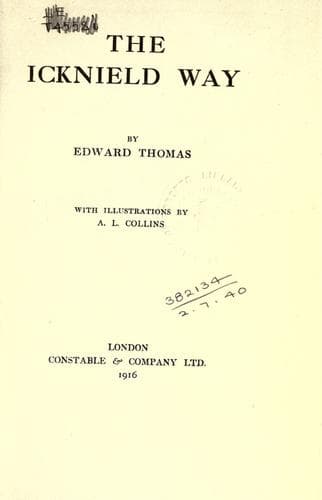
England -- Description and travel; Icknield Way (England); Thomas, Edward, 1878-1917
I was glad that I had taken _Pelican Island_ with me as my only book;
for if I had not I might very likely never have read it. Yet it might
have escaped me even though it was in my pocket. Unless a man always
carries a book with him, when he does take one it is often a little
too well chosen, or rather chosen too deliberately, because it is a
very good one, or is just the right one, or is one that ought to be
read. But walking is apt to relieve him of the kind of conscience that
obeys such choices. At best he opens the book and yawns and shuts
it. He may look about him for any distraction rather than this book.
He reads through a country newspaper, beginning and ending with the
advertisements. He looks at every picture in an illustrated magazine.
He looks out of the window for some temptation. He takes down _The
Lamplighter_ or Mrs. Humphry Ward’s _East Lynne_ from the landlord’s
shelves. He looks through the magazine again. If he opens the choice
book he finds in it an irresistible command to go to bed at nine
o’clock. The same book may be taken out thus a score of times, and
acquire a friendly and well-read appearance.
CHAPTER IX
SEVENTH DAY--STREATLEY TO SPARSHOLT, ON THE RIDGEWAY, BY SCUTCHAMER
KNOB AND LETCOMBE CASTLE
When I was next at Streatley I took the Ridgeway westward chiefly
because I like the Ridgeway, partly because I wished to see it again,
now that it had to give up the title conferred on it by Bishop Bennet,
of the Icknield Way. I went up from the bridge and at the “Bull”
turned to the right and northward along the Wantage road, which is
probably the Icknield Way. After getting well up on the chalk above the
river this road maintains the same level of from two to three hundred
feet, and for two miles keeps within a mile of the river on a terrace
half-way up the slope of the hills. Streatley had spread itself in red
spots along the side of the road, past the fork to Wallingford and up
to where the Ridgeway turns off to the left and westward into the long
coombe leading to Streatley Warren. At its mouth this coombe was wide
and shallow, and was all grass, except on the left hand where there
were new houses. In places, as by Rectory Farm, the road, a hard one,
had a pleasant green terrace above it with wild roses rambling over
it. The coombe deepened and the road ascended above a golf course
near Warren Farm. Thus far it was hedged, but soon, still mounting the
right wall of the long coombe, it was rough and hedgeless, and old
parallel tracks were to be seen above and below it. It was now near the
southern edge of Thurle Down Woods on its right. Below, on the left,
were the steep walls of the winding coombe, dotted by thorn, juniper,
and elder, and here called Streatley Warren. Of the unwooded coombes
or inlets into the downs this is one of the most pleasing to me, and I
shall always remember it, as I do the great coombe winding into Butser
Hill on the north side, and others of those vast turf halls which the
sky roofs.
Public-domain text, read in full here on John Shaqi.
Reviews
Reviews
No reviews yet
Be the first to share your thoughts on this work.
Elsewhere in the archive
Join the Discussion
Join the discussion
Sign in to leave a comment or review.
Sign InorCreate an account