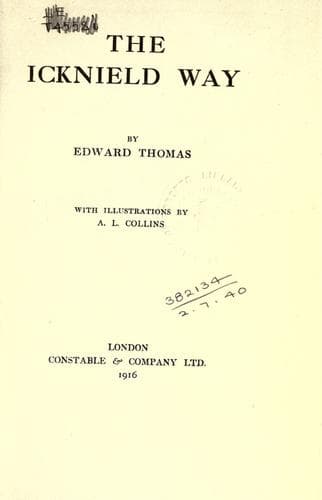
England -- Description and travel; Icknield Way (England); Thomas, Edward, 1878-1917
The hill was hedgeless save where a narrow, ancient road deeply
trenched it in ascending curves, lined by thorns. The road had probably
not been trodden since that procession of ten had descended towards
the town six miles away. A kestrel had killed a gold-crest upon the
bank, and as I approached it sailed away from the crimson-centred
circle of feathers on the snow. But the wind had been the chief
inhabitant of the slopes, and unseen of mortal eyes it had been
luxuriously, playfully carving the snow which submerged the hedge.
The curved wind-work in the drift, deeply ploughed or deliberately
chiselled, remained in the stillness as a record of the pure joy of
free, active life contented with itself. It was the same blithe hand
which had shaped the infant born in this black barn.
An old plum tree, planted when barn and house were built, and now dead
and barkless, stood against one end, and up it had climbed a thick
ivy stem that linked barn and tree inseparably with a profusion of
foliage, emerald and white. The last of its doors lay just outside in
the dead embers of the tramps’ fire. Thus open on both sides to the
snow-light and the air the barn looked the work rather of nature than
of man. The old thatch was grooved, riddled, and gapped, and resembled
a grassy bank that has been under a flood the winter through; covered
now in snow it had the outlines in miniature of the hill on which it
was built. The patched walls, originally of tarred timber laid in
horizontal planks, were of every hue of green and yellow that moss,
lichen, and mould can bestow, each strip of board being of a different
date and a different shade. What gave them something in common with one
another was the fresh black stains which ran from the melting eaves
to the nettle-bed below. The porches, lofty enough to admit a waggon
piled as high as possible with sheaves of corn, had slipped somewhat
away: it was to them alone that the exterior of the building owed a
faint suggestion of a church and, consequently, a pathetic, undermined
dignity: without them it would have seemed wholly restored to nature,
amiably and submissively ruinous, with a silence in which not the
most perverse mind could have detected melancholy. But within it was
unexpectedly lofty, and the ponderous open timber-work, rough-hewn and
naturally curved, was obviously performing too efficiently the task of
supporting the roof: it at once inspired the thought that it should
ere now have relaxed the strain of its crooked arms and acquiesced and
slipped or collapsed. The oak floor was pierced in many places by wear
and by drippings from the broken roof; grass and corn had grown up
through the crevices and died. Some of the fallen thatch had been piled
in a dry corner for a bed. In the centre of the floor was another sign
of its late use--squares chalked by the children for the playing of a
game. I walked to and fro. There were no ghosts, or so it seemed.
Public-domain text, read in full here on John Shaqi.
Reviews
Reviews
No reviews yet
Be the first to share your thoughts on this work.
Elsewhere in the archive
Join the Discussion
Join the discussion
Sign in to leave a comment or review.
Sign InorCreate an account