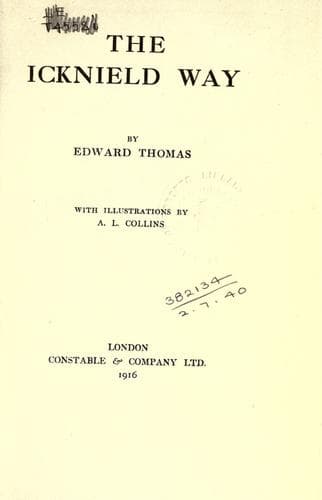
England -- Description and travel; Icknield Way (England); Thomas, Edward, 1878-1917
He and his wife and six children had arrived at the barn on Christmas
Eve. For a week before they had been at a barn nearer the village, but
as this had to be repaired they were turned out. They were allowed to
settle in Lone Barn because Bishopstone had done an occasional day’s
work for the farmer on whose land it stood. During January and February
he did several more days’ work. The wife and children remained in the
barn. The two eldest had measles, the sixth had pneumonia; all were
verminous. On Christmas Day a seventh had been born in Lone Barn. The
mother, who had fainted in court a week before and had been remanded,
pleaded guilty of neglect, but said that “she could not do in a barn
as she could in a cottage,” there being no bed, no furniture, and no
water except from a cattle pond half a mile away. The man had been
unable to get a cottage. The family had been found lying round a fire
in the barn, and after medical examination arrested. Bishopstone
hardly spoke in answer to the questions and insults of the bench, but
he was understood to say, “The Lord is on my side,” and several other
blasphemous or unintelligible things, which were no defence or excuse.
The nine were now condemned to the comfort of the workhouse and the
prison until haymaking time.
I went to Lone Barn again, the birthplace of Francis Albert Edward
Bishopstone.
The black brook, full of the white reflections of its snowy banks and
beginning to steam in the sun, was hourly growing and coiling all its
long loops joyously through the land. The dabchick was laughing its
long shrill titter under the alder roots. Faint, soft shadows fell on
to the snow from the oaks, whose grey skeletons were outlined in snow
against the clear deep blue of the now dazzling sky. Thrushes were
beginning to sing, as if it had always been warm and bright. In hedge
and thicket and tall wood, myriads of drops were falling and singing
in the still air. Against the south the smooth downs were white under
a diaphanous haze of grey, and upon them seemed to rest heavenly white
mountains, very still, dream-like, and gently luminous. Lone Barn lay
up in the haze invisible.
At the foot of the hills the land was divided by low hedges into broad
fields. There no birds sang and no stream gurgled. The air was full
of the pitiful cries of young lambs at their staggering play in the
shallow snow. One ewe stood with her new-born lamb in a stamped, muddy
circle tinged with blood amidst the pure white. The lamb was yellowish
green in colour; it stumbled at her teats, fell down and sucked upon
its knees. The big mother stood still, shaggy, stubborn, meek, with her
head down, her eyes upon me, her whole nature upon the lamb buried in
her wool, part of her.
Public-domain text, read in full here on John Shaqi.
Reviews
Reviews
No reviews yet
Be the first to share your thoughts on this work.
Elsewhere in the archive
Join the Discussion
Join the discussion
Sign in to leave a comment or review.
Sign InorCreate an account