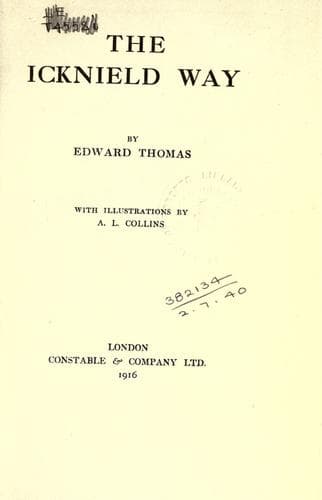
England -- Description and travel; Icknield Way (England); Thomas, Edward, 1878-1917
In fact, it is by this time rather venerably pretty. They
call the far-seen clump of beeches on Liddington Hill the “Folly”; the
clump a quarter-mile north-west of Wayland’s Smithy is Odstone Folly;
Ashbury Folly is the clump at the crossing over the Ridgeway down to
Ashbury Church. They call a house a “Folly” with less benevolence. They
see--or they feel--in the strange, high, or solitary situation part of
an attempt to mould the course and conditions of life, or to escape
from them. They see--or they dimly imagine--a being who is trying to
make his, or some woman’s, like a poem, or like a work of art--
Carved with figures strange and sweet,
All made out of the carver’s brain....
It is not that they see the blasphemy of it like that of Babel or of
the Titans. But they know that the builders of Babel and the Titans
will fail, and if they cannot beat them themselves they will be on the
side of the one who can. I should myself be sorry to see a house--such
a one as is likely to be built--on that island between Gramp’s and
Hackpen hills. But if it were such a house as Morgan’s Folly! I
warmed with the thought of transporting that hill-top tower to this
peninsulated table of turf, by the expenditure of a sum sufficient to
have given a free library to Letcombe Bassett.
I do not know if it was called a Folly, but there was a plantation
at the cross-road from Sparsholt to Lambourn which I liked--a long,
narrow plantation of beeches close together alongside the cross-road
and touching the Ridgeway on one side; on the other was a tumulus. Here
it was a broad road with no hedges, there being corn on the right, and
sheep, enclosed by a wire fencing, on the left. It was now near its
highest point, nearly eight hundred feet, at the Hill Barn that stands
with its company of stacks amidst a group of ash trees above Sparsholt.
The purple meadow crane’s-bill was growing beside the road near Hill
Barn.
I left the Ridgeway that morning by the Blowingstone Hill and its
woods, and went to Sparsholt, which has a quarter-mile of chestnut and
lime, and then beech and elm shadow on the road to its church. One bee
was buzzing inside as I walked over the stones and brasses of the floor
and looked at the Commandments, the Creed, the Lord’s Prayer, and the
royal arms, on the wall, but chiefly at three recumbent stone effigies
lying asleep and private within a chapel, guarded by stone lions,
railings, and a locked gate.
CHAPTER X
EIGHTH DAY--SPARSHOLT TO TOTTERDOWN, ON THE RIDGEWAY, BY WHITE HORSE
HILL AND WAYLAND’S SMITHY
Public-domain text, read in full here on John Shaqi.
Reviews
Reviews
No reviews yet
Be the first to share your thoughts on this work.
Elsewhere in the archive
Join the Discussion
Join the discussion
Sign in to leave a comment or review.
Sign InorCreate an account