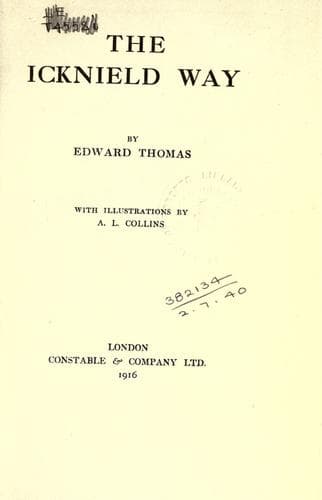
England -- Description and travel; Icknield Way (England); Thomas, Edward, 1878-1917
I was going through Sparsholt the next day just after the children had
gone into school after their mid-morning play. The road was quieter
than the church on that hot, bright morning. As I walked under the
garden trees I came slowly within hearing of a melody played so
lightly, or so far lost among winds or leaves, that I could hardly
distinguish it. It was an hour when nearly everyone is at work. A
poor, ragged girl was walking in front of me in awkward haste. But
she stopped at the same time as I did, to listen. The music was not
everything. The shadow and the filtered light, the silence of the music
half submerged, the busy hour so steeped in tranquillity, helped the
player to express perfect carelessness and freedom from the conditions
of life--summer, wealth, luxury, happiness, youth, gaiety, innocence,
and benevolence. They expressed it for us, as that river-side garden
picture at Watlington doubtless expressed it for others. But presently
the player lighted upon a melody which took me right away from
Sparsholt and the summer morning and the tranquillity. I could not
catch every note, but even the fragmentary skeleton of “Caradoc’s Hunt”
could not be mistaken. At a first hearing this old hunting song seemed
to be much the same thing as Scott’s
Waken, lords and ladies gay,
and little more than the north countryman’s
One morning last winter to Holm Bank there came
A noble brave sportsman, Squire Sandys was his name.
[Illustration: White Horse Hill.]
Many have heard it and thought it just one of the best, perhaps the
princeliest, of hunting songs. With a little change it might have been
a battle song; for it was martial and high-tempered, and would launch
cavalry as well as huntsmen. It was a little too nervously quick and
dancing for a battle song; such pace, such height of spirit could
not endure. Yet the trumpets before a charge have often brought the
song into the hearts of young soldiers, and their chargers and they
have done extravagant things for the gay tune’s sake. It suggested the
haughtiness and celerity of youth, audacious and fantastic pleasures,
voices of command and laughter, many-coloured and all splendid dresses,
neighing and prancing horses, hounds lazily quarrelling in the sun,
gallant March weather. The gates of a castle stood all wide open for
the first time since the beginning of winter, and arrowy winds and
humid fragrance were invading the stale shadows. As the first flowers
break out of the old, dark earth, so the youths and maidens with their
purple and gold, green and white, broke out of this old, dark castle
upon the Welsh moorland. The sharp horseshoes trampled the first
green of spring and the first yellow blossoms, even as the riders
would trample the hearts of men and women, and as freely upon their
own hearts, their own strength and health and happiness. The sunlight
played like a thousand sprites, on rippling waters, on the gold and
silver ornaments of riders and horses, on horns of gold.
Public-domain text, read in full here on John Shaqi.
Reviews
Reviews
No reviews yet
Be the first to share your thoughts on this work.
Elsewhere in the archive
Join the Discussion
Join the discussion
Sign in to leave a comment or review.
Sign InorCreate an account