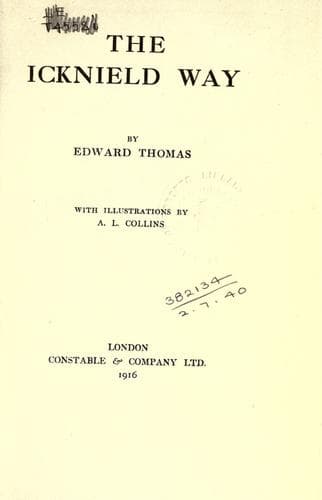
England -- Description and travel; Icknield Way (England); Thomas, Edward, 1878-1917
But I must confess the melody did not lighten my step as I mounted
again to the Ridgeway by Blowingstone Hill. The Blowingstone is a block
of brown, iron-like sarsen stone standing on end, and of such a height
that a man can bend over and comfortably blow into the mouthpiece at
the upper side. This natural mouthpiece is the small roundish entrance
to a funnel through the stone which emerges at a larger hole lower down
at the back. A well-breathed person blowing bugle-fashion can make a
booming that is said even now to carry five miles, if sustained for
some time. At the hill-top, where it stood before it became a procurer
of charity, a skilled and deep-chested hillman might have made himself
heard much farther. From this hill-top, nearly seven hundred feet high,
the Ridgeway rises to its greatest height. Hitherto it had hardly ever
had higher land on either side of it for very many miles. At Uffington
Castle it is over eight hundred feet high, but a little lower than the
highest part of the camp. From the rampart about this circle of almost
level turf I could see the Quarley Hill range and far over the Lambourn
Downs to Martinsell Hill by Savernake; I could see Barbury Castle and
the wooded hills of Clyffe and Wroughton, and Badbury, the Cotswolds,
the Oxfordshire hills, Sinodun, and the Chilterns. The Dragon Hill
below it is an isolated eminence shaped like the butt of an oak tree,
and similar to that one in the hollow between Gramp’s and Hackpen
hills, but ruder and more distinct.
Public-domain text, read in full here on John Shaqi.
Reviews
Reviews
No reviews yet
Be the first to share your thoughts on this work.
Elsewhere in the archive
Join the Discussion
Join the discussion
Sign in to leave a comment or review.
Sign InorCreate an account