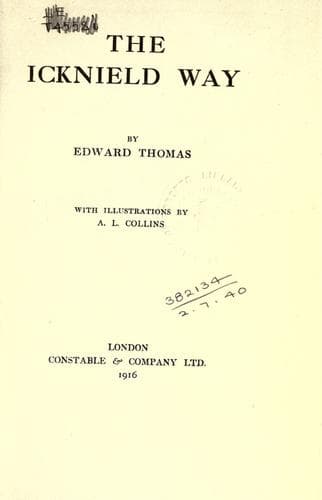
England -- Description and travel; Icknield Way (England); Thomas, Edward, 1878-1917
Past the south and lower side of Uffington Castle the Ridgeway went
fairly straight, with a thorn or two on either side, towards the thick
beech clump above Wayland’s Smithy, sometimes a green road, sometimes
worn white. The hill-side was divided among charlock and different
greens in squares and triangles, and here and there a thatched barn
or rick at a corner. Southward I saw the pleasant, dappled scatter of
Knighton Bushes over the turf, sometimes considerable woods like those
of Ashdown by Alfred’s Castle; in several places the long stretch of
turf reared itself up with beautiful but detached hills, like Tower
Hill, as high as the main ridge. The hot, misty sun drew out all the
odour from uncut grass, clover, cockscombs, yellow bedstraw, ox-eye
daisies, and bird’s-foot trefoil, and the light air mixed them.
Whatever was visible or hid on the left, the road always commanded the
northward valley, the main expanse, and also for the most part the
nearer land where the villages lay, close to the foot of the hills on
which it was travelling. An enemy might have lain or moved concealed
within a very short distance on the south, but never on the north, and
it might be conjectured, therefore, that attack was to be feared from
that side only, and that the other was friendly country to those most
commonly upon the road. The camps of Lowbury, Letcombe, and Uffington
were all to northward; Alfred’s Castle alone was on the south, at
Ashdown, among the greatest woods now surviving on this part of the
Downs. It is hardly possible for unhistorically minded men to think of
war on these hills, unless troops are manœuvring over them. Yet the
Ridgeway is like nothing so much as a battlement walk of superhuman
majesty. The hills between Streatley and Liddington form a curve in
the shape of a bow, a doubly curved Cupid’s bow. Following this line,
always keeping at the edge of the steep northward slope and surveying
the valley, the Ridgeway carries the traveller for thirty miles as if
along the battlements of a castle. He begins at Streatley by having the
early morning sun of spring over his right shoulder; the full light of
midday is on his left as he passes Letcombe Castle; the sun is going
down on his right hand as he descends to Totterdown and the pass for
the Roman road and modern traffic between the hills.
Public-domain text, read in full here on John Shaqi.
Reviews
Reviews
No reviews yet
Be the first to share your thoughts on this work.
Elsewhere in the archive
Join the Discussion
Join the discussion
Sign in to leave a comment or review.
Sign InorCreate an account