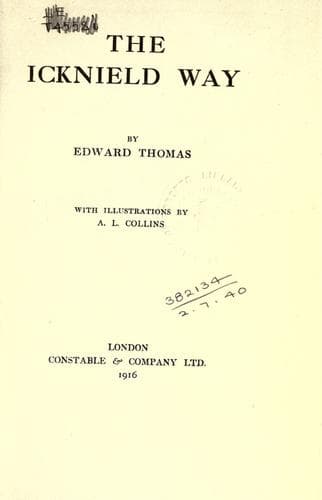
England -- Description and travel; Icknield Way (England); Thomas, Edward, 1878-1917
I have not had the fortune to meet drovers from Wales, but where the
Icknield Way through Buckinghamshire rounds the promontory Beacon
of the Ivinghoe Hills I have seen men with sheep from Berkshire
or Dorset journeying towards Dunstable, Royston, and the farms of
Cambridgeshire and Suffolk. They have to go much on the hard grit
to-day, and I have heard that they are kept off the unfenced Ridgeway
lest the flock should eat too much of the pastures in their passage.
The sheep dislike the grit as much as Mr. Burroughs loves it and I
hate it, and what with the traffic and the harshness of the road it
is not surprising to hear of a Welsh flock taking a week to get from
Warminster to Monckton Deverill.
Where the high down roads are fenced there could be no better
wayfaring. The track is twenty or thirty yards wide or more. It
is untouched by wheels, and grows nothing but grass and the most
delicate flowers. Along similar droves doubtless the sheep go up to
the alpine grass in summer, as the shepherd in California told Miss
Mary Austin.[5] “We went between the fenced pastures, feeding every
other day and driving at night. In the dark we heard the bells ahead
and slept upon our feet. Myself and another herdboy, we tied ourselves
together not to wander from the road.... Whenever shepherds from the
Rhone are met about camps in the Sierras they will be talking of how
they slept upon their feet and followed after the bells.” The best time
to meet travelling sheep is after one of the fortnightly markets at
East Ilsley among the Berkshire Downs, or at the time of the Ram Fair
there on August 1st, or at the time of Tan Hill Fair on August 6th,
or Yarnbury Fair on October 4th. Tan Hill and Yarnbury fairs are both
held within the circuit of an old camp on the high chalk. Yarnbury is
a meeting-place of trackways over Salisbury Plain. Tan Hill is close
to the great Ridgeway and other trackways. Tan is supposed by some to
be connected with the Celtic “tan,” meaning fire, and with Celtic
religious festivals having ceremonies of fire. This fair was held at
a very early hour, and there is an obvious temptation to suggest a
religious origin for the beacons said to have been lighted to guide the
drovers.[6] I do not know what number of sheep would be sold at this
fair. Defoe says that as many as five hundred thousand were sold at
Weyhill Fair, one farmer attending to represent ten or twenty in his
own county of Sussex or Oxfordshire. If this number came to Tan Hill
it was worth a night’s drenching to see the beacons and the multitudes
arriving, to hear the bells and the sea of tired bleating and the sharp
chiding of the overstrung dogs and the curses of the sleepy drovers
upon that smooth, bare mountain without house or hut or a white road,
or anything much newer than Wansdyke except the square of mustard that
began to dawn through the mist like a banner not far away.
[5] _The Flock_, by Mary Austin.
[6] _Wiltshire Archæological Magazine_, XXXIV.
Public-domain text, read in full here on John Shaqi.
Reviews
Reviews
No reviews yet
Be the first to share your thoughts on this work.
Join the Discussion
Join the discussion
Sign in to leave a comment or review.
Sign InorCreate an account