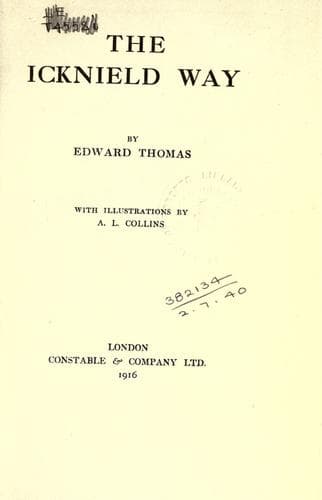
England -- Description and travel; Icknield Way (England); Thomas, Edward, 1878-1917
Perhaps if we walk long enough we shall discover something about roads.
There could be few better objects for walking, unless it be to meet a
mistress or to fetch a doctor. We walk for a thousand reasons, because
we are tired of sitting, because we cannot rest, to get away from towns
or to get into them, or because we cannot afford to ride; and for
permanent use the last is perhaps the best, as it is the oldest.
[8] See his Introduction to _The Footpath Way: an Anthology for
Walkers_.
[Illustration: The Icknield Way and Old Parallel Tracks, near
Newmarket.]
CHAPTER II
HISTORY, MYTH, TRADITION, CONJECTURE, AND INVENTION
Few in the multitude of us who now handle maps are without some vague
awe at the Old English lettering of the names of ancient things, such
as Merry Maidens, Idlebush Barrow, Crugian Ladies, or the plain Carn,
Long Barrow, or Dolmen. Not many could explain altogether why these are
impressive. We remember the same lettering in old mysterious books, and
in Scott’s _Marmion_ and Wordsworth’s _Hartleap Well_. We are touched
in our sense of unmeasured antiquity, we acknowledge the honour and the
darkness of the human inheritance. Most impressive of all, because they
recur across many counties, are the names of roads, like the Sarn Helen
of Wales, the Pilgrims’ Way of England. It is part of their power that
they have no obvious and limited significance, and were certainly not
bestowed by king or minister as names are given by a merchant to his
commodities. Instead of “London Road” we see “Watling Street”; instead
of “North Road” there is “Foss Way” or “Ermine Street.” But all these
make some appeal, however fantastical, to the intelligence. “Icknield
Street” or “Icknield Way” makes no such appeal. It is the name of
two apparently distinct roads: one with a Roman look running north
and south through Worcestershire and Warwickshire, the other winding
with the chalk hills through Suffolk, Cambridgeshire, Hertfordshire,
Bedfordshire, Buckinghamshire, Oxfordshire, Berkshire, and Wiltshire.
I shall confine myself as far as possible to this second road. It
runs south-westwards from East Anglia and along the Chilterns to the
Downs and Wessex; but the name is mysterious. For centuries--since
Holinshed--it was supposed to be connected with the East Anglian
kingdom of the Iceni: only fifty years ago Guest confidently translated
it as the warpath of the Iceni, and connected it with the names of
places along its course, such as Icklingham, Ickleton, and Ickleford.
To-day, it is pointed out with equal confidence that “according to
philological laws Iceni would have produced in England a form beginning
with Itch- or Etch-.” Dr. Henry Bradley cannot believe that there
was any knowledge of the Iceni in Berkshire, but finds it “a natural
supposition” that the road was called after a woman named Icenhild,
though he points out that no such person or name is known in myth or
history.
Public-domain text, read in full here on John Shaqi.
Reviews
Reviews
No reviews yet
Be the first to share your thoughts on this work.
Join the Discussion
Join the discussion
Sign in to leave a comment or review.
Sign InorCreate an account