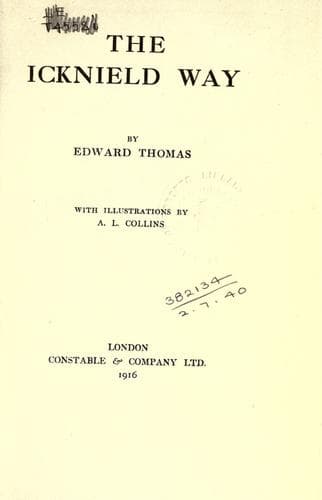
England -- Description and travel; Icknield Way (England); Thomas, Edward, 1878-1917
“The Ickleton-way has been ploughed up across Wantage East Field till
it enters Charlton (a hamlet of Wantage); it then passes through West
Lockinge. It is lost across Mr. Bastard’s park in East Lockinge, but
appears again from that park to Ginge Brook, in Ardington parish. It
passes by White’s barn in Sparsholt-court manor, and is afterwards
ploughed up for some way, but appears again, after crossing the
Newbury-way, by Wiltshire’s and Halve-hill barns, in East Hendred
parish; from thence through the parishes of Harwell, West Hagbourne,
and the hamlet of Upton, to the village of Blewbury, and through the
parishes of Aston Tirrold, and Cholsey, to Moulsford on the Thames,
and thence to Streatley; from Upton to Streatley it forms part of the
new turnpike road from Wantage to Reading.” From Upton station to
the east edge of Lockinge Park this road is now an almost continuous
series of cart-tracks known--at least, in the neighbourhood of East
Hendred, which it leaves half a mile to the north--as Ickleton Street
or Ickleton Meer. This evidence of 1911, confirming statements
made a hundred and two hundred years ago, is sufficient to identify
that portion of the road as Ickleton Street. Beyond Wantage, Wise’s
description can be applied only to the modern road from Wantage to
Bishopston, or as far as the “Calley Arms” at Wanborough. East of Upton
the modern road to Streatley--the old Reading turnpike--has a rival in
a series of cart-tracks through Blewbury and the Astons, and possibly
to be connected with the “Papist Way” near Cholsey.
[Illustration: “Ickleton Meer,” Hagbourne Hill, near Upton, Berks.]
Thus there is traditional authority for giving the name of Ickleton
Street or Way to a series of roads in Berkshire between Bishopston and
Streatley, and the name of Icknield or Icnal Way to a road leading from
Royston to Goring; and hence a probability that the two were united by
the ford between Streatley and Goring. To this can be added a strong
impression that this road came from a Norfolk port and went westward to
Avebury, and thence or by another route into Devon or Cornwall; but not
one writer, except perhaps Aubrey’s friend, proves or even implies a
contemporary use of this road throughout its course; while Drayton and
Plot suggest that it had fallen into decay in their time.
Along with “Mr. Church, surveyor of Wantage,” in Lysons’ _Berkshire_,
appeared a bishop, John Bennet (1746-1820), Bishop of Cloyne from
1794 until his death. Without any argument or evidence he makes the
following pronouncement, heralded by the editorial opinion that “his
researches have enabled him to speak with certainty on the subject”:--
Public-domain text, read in full here on John Shaqi.
Reviews
Reviews
No reviews yet
Be the first to share your thoughts on this work.
Join the Discussion
Join the discussion
Sign in to leave a comment or review.
Sign InorCreate an account