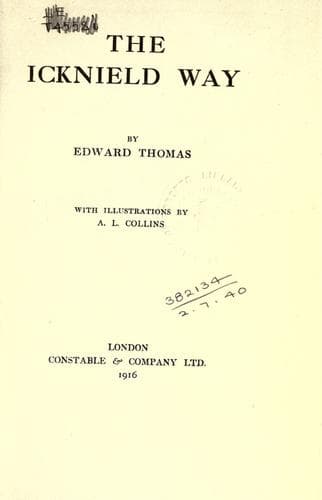
England -- Description and travel; Icknield Way (England); Thomas, Edward, 1878-1917
“Five o’clock, sir,” said the Cockney at my door next morning, and I
looked out to see a hot day slowly and certainly preparing in mist and
silence. There was nobody in the fields. The hay-waggon stood by the
rick where it had arrived too late to be unloaded last night. To one
bred in a town this kind of silence and solitariness perhaps always
remains impressive. We see no man, no smoke, and hear no voice of man
or beast or machinery, and straightway the mind recalls very early
mornings when London has lain silent but for the cooing of pigeons.
That silence of so many things that can and will make sounds gives some
of its prestige to the country silence of very quiet things. Therefore
when I have looked out of a strange window for the first time and seen
nothing move but leaves on the earth and clouds in the sky, I have
often for a moment felt as if it were dawn and have slipped into a mood
of dawn; it might be possible on a cloudy day and in a new country to
be deceived thus even at noon. Thus the innocence of silent London is
transferred to the downs, the woods, the vacant fields, and the road
without a wheel or a foot upon it for miles and miles.
I had about forty miles to cover before the end of the daylight, so
I had to help myself by driving with my host and his “old son” John.
I was now thoroughly foot-sore. One foot was particularly bad, and
in trying to save it I used different muscles in the leg, which were
quickly tired. Then, to help myself, I had leaned heavily on my stick
at every step and so brought arm and shoulder to a state of discomfort,
if not pain. Finally, the stick was unsuitable for its purpose and
sorely afflicted the palm of the hand that grasped it. I had carried
the stick for many single days of walking and liked it. For it was a
tapered oak sapling cut in the Weald and virtually straight because
its slightly spiral curves counteracted one another. But it had almost
no handle, and so drove itself into one small portion of the palm when
leaned on. It had also in the winter shown itself hard to retain in
the hand when a few inches of it were in mud. Nevertheless, it was so
nicely balanced and being oak so likely to last a lifetime that, for
six years, I put up with its faults, and now, having been in my company
for so many miles in a splendid June, it has a fresh hold upon me. Also
I am not certain that any other handle, a larger and rounder knob or a
stout natural crook, would have been much better in a hand not made of
iron. Perhaps a really long staff grasped some way from its upper end
would be right. But there is something too majestic, patriarchal even,
about such a staff. A man would have to build up his life round about
it if it had been deliberately adopted. And gradually he would become
a celebrity. Of course, if he had an inclination towards such a staff,
as the natural and accredited form among pedestrians, there would
be an end of the matter, but that is not very likely in a town-bred
Englishman.
Public-domain text, read in full here on John Shaqi.
Reviews
Reviews
No reviews yet
Be the first to share your thoughts on this work.
Elsewhere in the archive
Join the Discussion
Join the discussion
Sign in to leave a comment or review.
Sign InorCreate an account