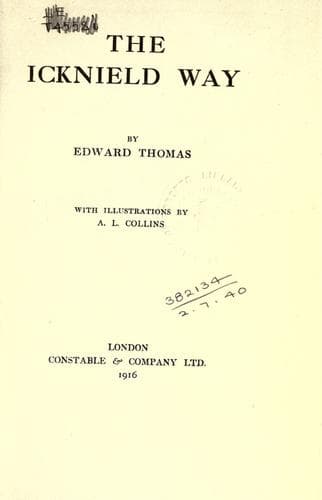
England -- Description and travel; Icknield Way (England); Thomas, Edward, 1878-1917
The landlady at my inn was the first that ever told me outright, at
once, and without being asked, what she charged for a bed, and as the
sum was reasonable I was doubly pleased. She was a jaunty, probably
childless London woman not far from forty, who referred to her husband
as “my sweetheart.” She had a skittish, falsetto laugh, whether she was
talking to me about their old horse John and all his merits, or to the
labourers about such and such a “sweet old house” in the neighbourhood.
They were speaking of the coronation bonfire that was building on the
Beacon Hill, and she became important and full of reminiscences of
the Hampstead Heath bonfire, and, thereanent, the Spaniards, Vale of
Health, and so on. She hovered between them and me, anxious to tell
me that much as she liked a country life she missed the gas and the
bathroom of a London house. Now and then she left us all, to talk to
the parrot in a loud voice intended for mankind as well as Polly. Her
“sweetheart” turned out to be a little active man, superficially jaunty
but silent and brooding and hanging down his head. He was sandy-haired
with dull, restless, blue eyes, and had not recently been shaved. His
turned-out feet stepped quickly hither and thither. He was dressed
anyhow and as if he slept in his clothes to ensure a fit; a white scarf
was tied round his neck and his trousers were turned up. He carried a
cigarette either in the corner of his mouth or behind his ear. He was
one of those creatures provided by an almighty providence for attending
on that “noble animal” (such he called it) the horse; but this did not
prevent him from calling his own horse John “old son.” He never carried
a whip, because, he said, he did not believe in hurting “dumb animals.”
A man who knows horses well is equally at home in town or country, and
though this man was as full-blooded a Cockney as his wife, he was, like
her, contented with his three or four years of country solitude; it
was, he said, a “happy life, yes, a happy life,” better than what we
had learnt to call the “bustle and confusion” of London. I asked him
about the Icknield Way, which he knew by that name, and he told me that
it was a Roman road and that he had heard a man could walk on it for
twelve months and come back to the same place again. What that place
was he did not say; probably he meant any place and imagined that the
road made a circuit of this island or belike of the great globe itself.
There could be no better landlord and landlady of a small wayside inn
with one horse, one trap, and one spare bed. The bed was clean and
comfortable, and I fell asleep in it while the stone-curlews were
piping on the downs and a pair of country wheels were rolling by, late
and slow.
CHAPTER VI
FOURTH DAY--EDLESBOROUGH TO STREATLEY, ON THE UPPER ICKNIELD WAY, BY
WENDOVER, KIMBLE, WHITELEAF, GIPSIES’ CORNER, IPSDEN, AND CLEEVE
Public-domain text, read in full here on John Shaqi.
Reviews
Reviews
No reviews yet
Be the first to share your thoughts on this work.
Elsewhere in the archive
Join the Discussion
Join the discussion
Sign in to leave a comment or review.
Sign InorCreate an account