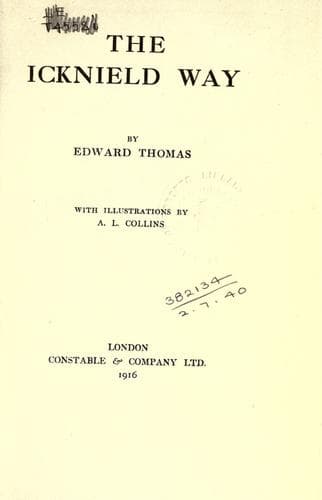
England -- Description and travel; Icknield Way (England); Thomas, Edward, 1878-1917
This road between the Chilterns and the corn was followed by a single
line of telegraph wire. It had a slightly raised green edge on the
right, marked by footpaths. It went within a few yards of the moated
castle of Shirburn. Here, says the marvelling countryside, the
drawbridge is nightly drawn up, presumably with the philanthropic
motive of giving work to somebody. I wished to see the castle as the
home of a library which has lately given to the world a collection of
ballads from manuscript of the early sixteenth century--“The Shirburn
Ballads.” But a great length of eight-foot wall alongside the road shut
off the view. It was a bad wall too, and could not be liked or admired
for its own sake. I succeeded only in seeing one new battlemented
tower, which, I was told, supplied water for the castle laundry. The
best thing at Shirburn was almost opposite the castle entrance--a
narrow strip of land raised above the road, and protected from it by
a row of goodly elm trees, so that I walked between a high hedge and
them in a private coolness and green gloom as of an airy church about
a hundred yards long. On the hedge side of this strip there was a
depression which might have been the old road: or perhaps at one time
the elms stood in the middle of the road like those yonder on the Upper
Icknield Way under Watlington Hill. Hereby they have set up the reputed
remains of one of Queen Eleanor’s funeral crosses.
[Illustration: Watlington.]
Watlington is a big square village of no great beauty or extraordinary
antiquity, all of a piece and rustic, but urban in its compression of
house against house. A castle stood at the north edge near the present
church. The Oxford road bounds the town on its garden side, where
farm-houses begin and cottages with gardens of monkshood and roses.
Near this road there was a “pleasure fair,” where the roundabouts and
swings of some travelling company were putting in time on their way
to a bigger town and a regular engagement. There must be great wisdom
in the men of Watlington, to be able to harmonize their grave, rustic
streets with the town-bred music as of a steam-engine in pain. It was
a feat I could not accomplish. The most I could do was to go into a
taproom, where the music did not penetrate and the weary were at rest.
It was a most beautiful evening, and the swifts were shrieking low down
along the deserted streets at nine o’clock. I should like to see them
crowded with sheep from Ilsley, and the old drover wearing a thistle
in his cap, or with Welsh ponies going to Stokenchurch Fair over the
Chilterns. But there is no market at Watlington, and nothing but a
“pleasure” fair; a cheap week-end railway ticket to London pleases the
country people by making them feel near London, whether they go or
not; and it may encourage new residents. This was what my host wanted;
his taproom was much too peaceful for living men, though he liked well
enough to smoke his last pipe there, sitting in his shirt sleeves
Public-domain text, read in full here on John Shaqi.
Reviews
Reviews
No reviews yet
Be the first to share your thoughts on this work.
Elsewhere in the archive
Join the Discussion
Join the discussion
Sign in to leave a comment or review.
Sign InorCreate an account