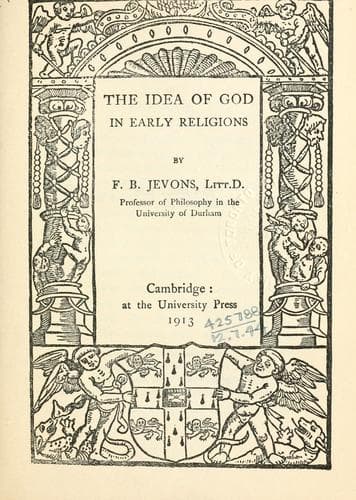
The Idea of God in Early ReligionsJevons, F. B. (Frank Byron)
Religion
The Idea of God in Early Religions
Jevons, F. B. (Frank Byron)
God; Religion
That some trust and confidence is indispensable in the complex feeling
with which a community approaches its gods, for the purpose of
appeasing their wrath--still more, for beseeching favours from
them--seems indisputable. But we must not exaggerate it. Wherever
there are gods at all, they are regarded by the community as beings
who can be approached: so much confidence, at least, is placed in them
by the community that believes in them. Even if they are offended and
wrathful, the community is confident that they can be appeased: the
community places so much trust in them. Indeed its trust goes even
further: it is sure that they do not take offence without reasonable
grounds. If they display wrath against the community and send calamity
upon it, it is, and in the opinion of the community, can only be,
because some member of the community has done that which he should not
have done. The gods may be, on occasion, wrathful; but they are just.
They are from the beginning moral beings--according to such standard
of morality as the community possesses--and it is breaches of the
tribe's customary morality that their wrath is directed against. They
are, from the beginning, and for long afterwards in the history of
religion, strict to mark what is amiss, and, in that sense, they are
jealous gods. And this aspect of the Godhead it is which fills the
larger part of the field of religious consciousness, not only in the
case of peoples who have failed to recognise the unity of the Godhead,
but even in the case of a people like the Jews, who did recognise it.
The other aspect of the Godhead, as the God, not merely of mercy and
forgiveness, but of love, was an aspect fully revealed in Christianity
alone, of all the religions in the world.
But the love God displays to all his children, to the prodigal son as
well as to others, is not a mere attribute assigned to Him. It is not
a mere quality with which one religion may invest Him, and of which
another religion, with equal right, may divest Him. The idea of God
does not consist merely of attributes and qualities, so that, if you
strip off all the attributes and qualities, nothing is left, and the
idea is shown to be without content, meaning or reality.
Public-domain text, read in full here on John Shaqi.
Reviews
Reviews
No reviews yet
Be the first to share your thoughts on this work.
Join the Discussion
Join the discussion
Sign in to leave a comment or review.
Sign InorCreate an account