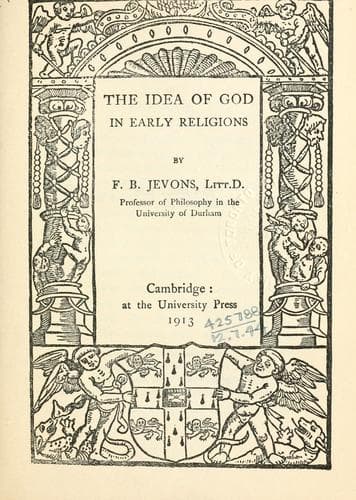
The Idea of God in Early ReligionsJevons, F. B. (Frank Byron)
Religion
The Idea of God in Early Religions
Jevons, F. B. (Frank Byron)
God; Religion
---- The Golden Bough. London, 1900.
---- Psyche's Task. London, 1909.
Gardner, P. Modernity and the Churches. London, 1909.
Hobhouse, L.T. Morals in Evolution. London, 1906.
Höffding, H. The Philosophy of Religion (English Translation).
London, 1906.
Hollis, A.C. The Masai. Oxford, 1905.
---- The Nandi. Oxford, 1909.
James, W. The Varieties of Religious Experience. London, 1902.
Jastrow, M. Jun. Study of Religion. London, 1901.
Jevons, F.B. Introduction to the History of Religion. London,
1896.
---- Religion in Evolution. London, 1906.
---- Study of Comparative Religion. London, 1908.
Lang, A. Magic and Religion. London, 1901.
---- The Making of Religion. London, 1898.
Mackenzie, W.D. The Final Faith. London, 1910.
Marett, R.R. The Threshold of Religion. London, 1909.
Mitchell, H.B. Talks on Religion. London, 1908.
Nassau, R.H. Fetichism in West Africa. London, 1904.
Parker, K.L. The Euahlayi Tribe. London, 1905.
Saussaye, P.D.C. de la. Religionsgeschichte. Freiburg i. B., 1889.
Schaarschmidt, C. Die Religion. Leipzig, 1907.
Thompson, R.C. Semitic Magic. London, 1908.
Tisdall W. St C. Comparative Religion. London, 1909.
Transactions of the Third International Congress of the History of
Religions. Oxford, 1908.
Tylor, E.B. Primitive Culture. London, 1873.
Westermarck, E. Origin and Development of Moral Ideas. London,
1906.
Wundt, W. Völkerpsychologie. Leipzig, 1904-6.
I
INTRODUCTION
Every child that is born is born of a community and into a community,
which existed before his birth and will continue to exist after his
death. He learns to speak the language which the community spoke
before he was born, and which the community will continue to speak
after he has gone. In learning the language he acquires not only words
but ideas; and the words and ideas he acquires, the thoughts he thinks
and the words in which he utters them, are those of the community from
which he learnt them, which taught them before he was born and will go
on teaching them after he is dead. He not only learns to speak the
words and think the ideas, to reproduce the mode of thought, as he
does the form of speech, of the circumambient community: he is taught
and learns to act as those around him do--as the community has done
and will tend to do. The community--the narrower community of the
family, first, and, afterwards, the wider community to which the
family belongs--teaches him how he ought to speak, what he ought to
think, and how he ought to act. The consciousness of the child
reproduces the consciousness of the community to which he belongs--the
common consciousness, which existed before him and will continue to
exist after him.
Public-domain text, read in full here on John Shaqi.
Reviews
Reviews
No reviews yet
Be the first to share your thoughts on this work.
Join the Discussion
Join the discussion
Sign in to leave a comment or review.
Sign InorCreate an account