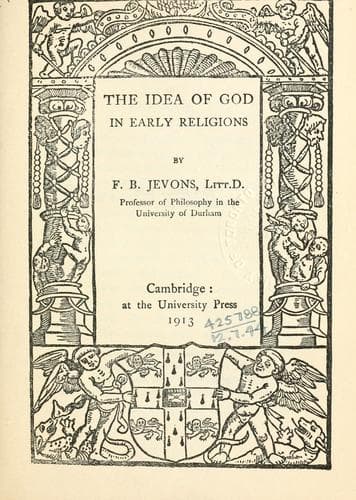
The Idea of God in Early ReligionsJevons, F. B. (Frank Byron)
Religion
The Idea of God in Early Religions
Jevons, F. B. (Frank Byron)
God; Religion
A certain presumption that myths tend to the degradation of religion
is created by the mere use of the term 'mythology.' It has come to be
a dyslogistic term, partly because all myths are lies, but still more
because some of them are ignoble lies. It becomes necessary,
therefore, to remind ourselves that, though we see them to be untrue,
they were not regarded as untrue by those who believed in them; and
that many of them were not ignoble. Aeschylus and Sophocles are
witnesses, not to be disbelieved, on these points. In their writings
we have the reflections of polytheists upon the actions and attributes
of the gods. But the reflections made by Aeschylus and Sophocles, and
their treatment of the myths, must be distinguished from the myths,
which they found to hand, just as the very different treatment and
reflection, which the myths received from Euripides, must be
distinguished from them. In both cases, the treatment, which the myths
met with from the tragedians, is to be distinguished from the myths,
as they were current among the community before and after the plays
were performed. The writings of the tragedians show what might be made
of the myths by great poets. They do not show what the myths were in
the common consciousness that made them. And the history of mythology
after the time of the three great tragedians makes it clear enough
that even so noble a writer as Aeschylus could not impart to mythology
any direction other than that determined for it by the conditions
under which it originated, developed and ran its course.
Public-domain text, read in full here on John Shaqi.
Reviews
Reviews
No reviews yet
Be the first to share your thoughts on this work.
Join the Discussion
Join the discussion
Sign in to leave a comment or review.
Sign InorCreate an account