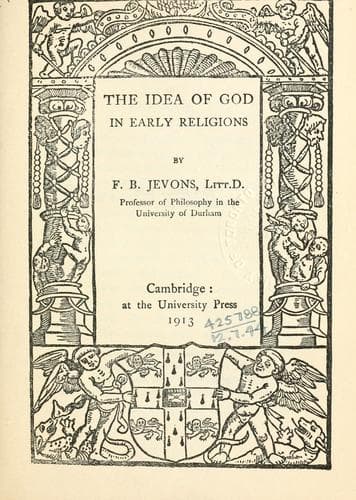
The Idea of God in Early ReligionsJevons, F. B. (Frank Byron)
Religion
The Idea of God in Early Religions
Jevons, F. B. (Frank Byron)
God; Religion
It is an induction, as wide as the world--being based on mythologies
from all parts of the world--that myths are aetiological, that their
purpose is to give the reason of things, to explain the origin of
fire, agriculture, civilisation, the world--of anything, in fact, that
to the savage seems to require explanation. In the animistic period,
man found gods everywhere because everywhere he was looking for gods.
To every object that arrested his attention, in the external world, he
put, or might put, the question, 'Art thou there?' Every happening
that arrested the attention of a whole community, and provoked from
the common consciousness the affirmation, 'Thou art there,' was, by
that affirmation, accepted as the doing of a god. But neither at this
stage, nor for long after, is there any myth. The being, whose
presence is thus affirmed, has at first no name: his personality is of
the faintest, his individuality, the vaguest. Mythology does not begin
until the question is put, 'Why has the god done this thing?' A myth
consists, or originally consisted, of the reason which was found and
adopted by the common consciousness as the reason why the god did what
he did do. It is in this sense that myths are aetiological. The
imagination which produces them is, in a sense, a 'scientific
imagination.' It works within limits. The data on which it works are
that this thing was done, or is done, by this god; and the problem set
to the mythological imagination is, 'Why did he, or does he, do it?'
The stories which were invented to answer this question constituted
mythology; and the fact that myths were invented for the purpose of
answering this question distinguishes them from stories in the
invention of which the imagination was not subject to restriction, was
not tied down to this god and to this action of his, and was not
limited to the sole task of imagining an answer to the question, 'Why
did he do it?' All myths are narratives, but not all narratives are
myths. Some narratives have men alone for their heroes. They are
imaginative but not mythological. Some narratives are about gods and
what they did. Their purpose is to explain why the gods did what they
did do, and those narratives are mythological.
Public-domain text, read in full here on John Shaqi.
Reviews
Reviews
No reviews yet
Be the first to share your thoughts on this work.
Join the Discussion
Join the discussion
Sign in to leave a comment or review.
Sign InorCreate an account