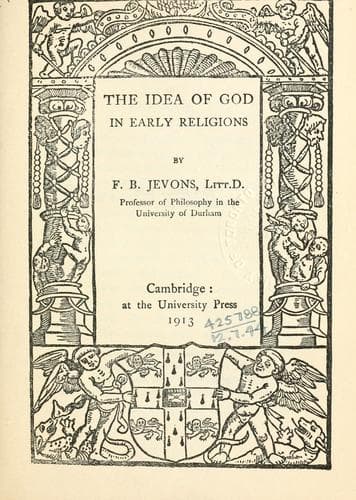
The Idea of God in Early ReligionsJevons, F. B. (Frank Byron)
Religion
The Idea of God in Early Religions
Jevons, F. B. (Frank Byron)
God; Religion
We have now to consider the new phase of the sacrificial--indeed, in
this connection, we may say the sacramental--rite which was found in
Mexico, and to indicate the manner in which it probably originated.
The offerings earliest made to the gods were not necessarily, but were
probably, food-offerings, animal or vegetable; and as we are not in a
position to affirm that there was any restriction upon the kind of
food offered, it seems advisable to assume that any kind of food might
be offered to any kind of god. The intention of offerings seems to be
to indicate merely that the worshippers desire to be pleasing in the
sight of the god whom they wish to approach. At this, the simplest and
earliest stage of the rite, the sacrificial feast has not yet come
into existence: it is enough if the food is offered to the god; it is
not necessary that it should be eaten, or that any portion of it
should be eaten, by the community. There is evidence enough to warrant
us in believing that generally there was an aversion to eating the
god's portion. If the worshippers ate any portion, they certainly
would not eat and did not eat, until after the god had done so. At
this stage in the development of the rite, the offerings are
occasional, and are not made at stated, recurring, seasons. The reason
for believing this is that it is on occasions of alarm and distress
that the community seeks to draw near its god. But though it is in
alarm that the community draws nigh, it draws nigh in confidence that
the god can be appeased and is willing to be appeased. It is part of
the community's idea of its god that he has the power to punish; that
he does not exercise his power without reason; and that, as he is
powerful, so also he is just to his worshippers, and merciful.
Public-domain text, read in full here on John Shaqi.
Reviews
Reviews
No reviews yet
Be the first to share your thoughts on this work.
Join the Discussion
Join the discussion
Sign in to leave a comment or review.
Sign InorCreate an account