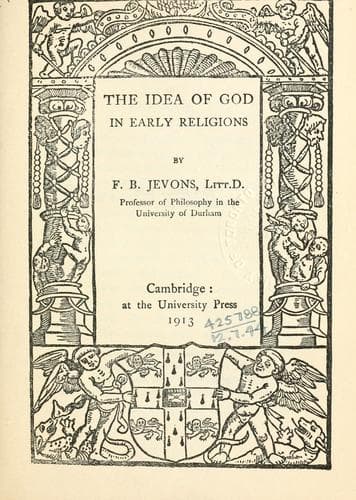
The Idea of God in Early ReligionsJevons, F. B. (Frank Byron)
Religion
The Idea of God in Early Religions
Jevons, F. B. (Frank Byron)
God; Religion
In all systems of worship man not only turns to his gods but does so
in the conviction that he is returning, or trying to return, to
them--trying to return to them, because they have been estranged, and
access to them is therefore difficult. Accordingly, he draws near to
them, bearing in his hands something intended to express his desire to
return to them. The material, external symbol of his desire--the
oblation, offering or sacrifice which he brings with him because it
expresses his desire--is that on which at first his attention centres.
And because his attention centres on it, the rite of sacrifice, the
outward ceremony, develops in ways already described. The object of
the rite is to procure access to the god; and the greater the extent
to which attention is concentrated on the right way of performing the
external acts and the outward ceremony, the less attention is bestowed
upon the inward purpose which accompanies the outward actions, and for
the sake of which those external actions are performed. As the object
of the rite is to procure access, it seems to follow that the proper
performance of the rite will ensure the access desired. The reason why
access is sought, at all, is the belief--arising on occasions when
calamity visits the community--that the god has been estranged, and
the faith that he may yet become reconciled to his worshippers. The
reason why his wrath descends, in the shape of calamities, upon the
community, is that the community, in the person of one of its members,
has offended the god, by breaking the custom of the community in some
way. For this reason--in this belief and faith--access is sought, by
means of the sacrificial rite; and the purpose of the rite is assumed
to be realised by the performance of the ceremonies, in which the
outward rite consists. The meaning and the value of the outward
ceremonies consists in the desire for reconciliation which expresses
itself in the acts performed; and the mere performance of the acts
tends of itself to relieve the desire. That is why the covenant-theory
of sacrifice gains acceptance: it represents--it is an official
representation--that performance of the sacrificial ceremony is all
that is required, by the terms of the agreement, to obtain
reconciliation and to effect atonement. But the representation is
found to be a misrepresentation: the desire for reconciliation and
atonement is not to be satisfied by outward ceremonies, but by
hearkening and obedience. 'To obey is better than sacrifice and to
hearken than the fat of rams.' Sacrifice remains the outward rite, but
it is pronounced to have value only so far as it is an expression of
the spirit of obedience. Oblations are vain unless the person who
offers them is changed in heart, unless there is an inward, spiritual
process, of which the external ceremony is an expression. Though this
was an interpretation of the meaning of the sacrificial rite which was
Public-domain text, read in full here on John Shaqi.
Reviews
Reviews
No reviews yet
Be the first to share your thoughts on this work.
Join the Discussion
Join the discussion
Sign in to leave a comment or review.
Sign InorCreate an account