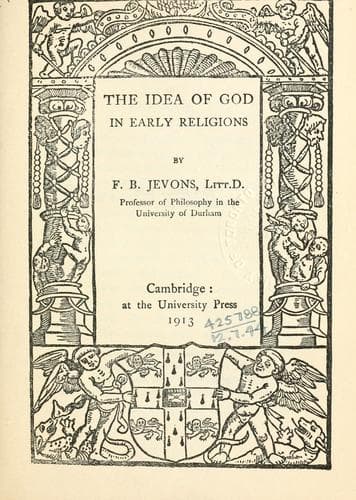
The Idea of God in Early ReligionsJevons, F. B. (Frank Byron)
Religion
The Idea of God in Early Religions
Jevons, F. B. (Frank Byron)
God; Religion
is employed for purposes, such as murder, which the common
consciousness condemns. Accordingly the person who has the power to
work the marvels comprehended under the name of magic is viewed with
condemnation, toleration or approval, according as he uses his power
for purposes which the common consciousness condemns, tolerates or
approves. The power which such a person exerts is power personal to
him; and yet it is in a way a power greater and other than himself,
for he has it not always under his control or command: whether he
uses it for the benefit of the community or for the injury of some
individual, he cannot count on its always coming off. And this fact is
not without its influence and consequences. If he is endeavouring to
use it for the injury of some person, he will explain his failure as
due to some error he has committed in the _modus operandi_, or to the
counter-operations of some rival. But if he is endeavouring to
exercise it for the benefit of the community, failure makes others
doubtful whether he has the power to act on behalf of the community;
while, on the contrary, a successful issue makes it clear that he has
the power, and places him, in the opinion both of the community and of
himself, in an exceptional position: his power is indeed in a way
personal to himself, but it is also greater and other than himself.
His sense of it, and the community's sense of it, is reinforced and
augmented by the approval of the common consciousness, and by the
feeling that a power, in harmony with the common consciousness and the
community's desires, is working in him and through him. This power,
thus exercised, of working marvels for the common good is obviously
more closely analogous to that of a prophet working miracles, than it
is to that of the witch working injury or death. And, in the same way
that I have already suggested that gods and fetishes may have been
evolved from a prior indeterminate concept, which was neither but
might become either; so I would now suggest that miracles are not
magic, nor is magic miracles, but that the two have been
differentiated from a common source. And if the polytheistic gods,
which are to be found where fetishism is believed in, present us with
a very low stage in the development of the idea of a 'perfect
personality,' so too the sort of miracles which are believed in, where
the belief in magic flourishes, present us with a very low stage in
the development of the idea of an almighty God. Axe-heads that float
must have belonged originally to such a low stage; and rods that turn
into serpents were the property of the 'magicians of Egypt' as well as
of Aaron.
Public-domain text, read in full here on John Shaqi.
Reviews
Reviews
No reviews yet
Be the first to share your thoughts on this work.
Join the Discussion
Join the discussion
Sign in to leave a comment or review.
Sign InorCreate an account