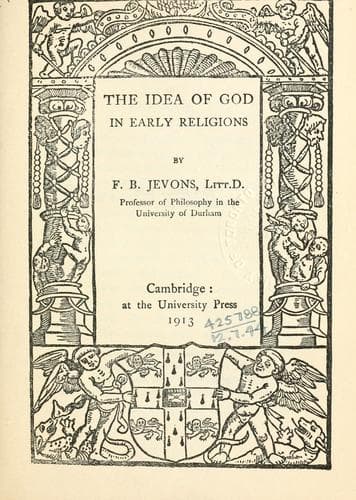
The Idea of God in Early ReligionsJevons, F. B. (Frank Byron)
Religion
The Idea of God in Early Religions
Jevons, F. B. (Frank Byron)
God; Religion
Let us then assume that this was the case with some of these Maklu
petitions, and let us consider what is implied when we make the
assumption. What is implied is that there are some wishes, for
instance those embodied in these Maklu petitions, which may be
realised by means of spells, or may quite appropriately be preferred
to the gods of the community. Such are wishes for the well-being of
the individual worshipper and for the defeat of evil-doers who would
do or are doing him wrong. When it is recognised that individuals--as
well as the community--may come with their plaints before the gods of
the community, the functions of those gods become enlarged, for they
are extended to include the protection of individual members of the
community, as well as the protection of the community, as such; and
the functions of the community's gods are thus extended and enlarged,
because the members of the community have become, in some degree,
individuals conscious of their individuality. The importance, for the
science of religion, of this development of self-consciousness is that
the consciousness of self must be realised before self can
consciously be abandoned, that is before self-will can be consciously
surrendered.
As is shown by the Maklu petitions, there may come, in the course of
the evolution of religion, a stage in which it is recognised that the
individual worshipper may petition the gods for deliverance from the
evil which afflicts them. And the petitions used appear in some cases,
as we have seen, to have been adopted into the ritual of the gods,
word for word as they were found already in existence. If then they
were, both in the words in which they were expressed, and in the
purpose which they sought to achieve, such that they could be taken
up, as they were and without change, into the ritual of the
community's gods, it would seem that, even before they were so taken
up, they could not have been wholly, if at all, alien to the spirit of
religion. What marks them as religious, in the cuneiform inscriptions,
is their context: it shows that the power, relied on for the
accomplishment of the desires expressed in these petitions, was the
power of the gods. Remove the context, and it becomes a matter of
ambiguity, whether the wish is supposed, by those who utter it, to
depend for its realisation on some power, possessed and exercised by
those who express the wish, or whether it is supposed to depend on the
good will of some being vaguely conceived, and not addressed by name.
But if eventually the wish, and the words in which it was expressed,
are taken up into the worship of the gods, there seems a balance of
probability that the wish was from the beginning rather in the nature
of religion than of magic, rather a petition than a command; though
the categories were not at first discriminated, and there was at first
no clear vision of the quarter from which fulfilment of the wish was
hoped for.
Public-domain text, read in full here on John Shaqi.
Reviews
Reviews
No reviews yet
Be the first to share your thoughts on this work.
Elsewhere in the archive
Join the Discussion
Join the discussion
Sign in to leave a comment or review.
Sign InorCreate an account