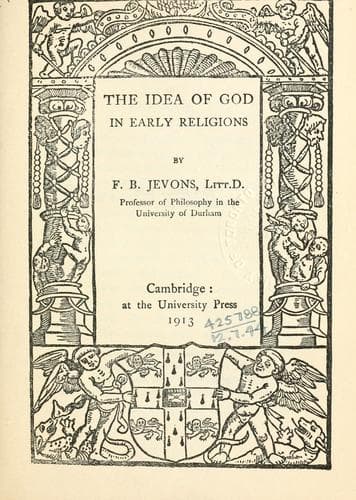
The Idea of God in Early ReligionsJevons, F. B. (Frank Byron)
Religion
The Idea of God in Early Religions
Jevons, F. B. (Frank Byron)
God; Religion
From this point of view, optative sentences, sentences which express
the wishes of him who pronounces them, may, in the beginning, well
have been ambiguous, because there was, in the minds of those who
uttered them, no clear conception of the quarter to which they were
addressed: the idea of God may have been vague to the extreme of
vagueness. Some of these optative sentences however, were such that
the community as a whole could join in them; and they were
potentially, and became actually, prayers to the god of the community.
The being to whom the community, as a whole, could pray, was thereby
displayed as the god of the community. The idea of God became, so far,
somewhat less vague, somewhat more sharply defined. Optative
sentences, however, in which the community could not join, in which no
one but the person who framed them could take part, could not be
addressed to the god of the community. The idea of God thus was
defined negatively: there were wishes which could not be communicated
to him--those which were repugnant to the well-being of the community.
The prayers of savages, that is of the men who are probably still
nearest to the circumstances and condition of primitive man, furnish
the material from which we can best infer what was the idea of God
which was present in their consciousness at those moments when it was
most vividly present to them. In view of the infinite number and
variety of the forms of religion and religious belief, nothing would
seem, _a priori_, more reasonable than to expect an equally infinite
number of various and contradictory ideas. Especially should this seem
a reasonable expectation to those who consider the idea of God to be
fundamentally, and of its very nature, impossible and untenable. And
so long as we look at the attempts which have been made, by means of
reflection upon the idea, to body it forth, we have the evidence of
all the mythologies to show the infinite variety of monstrosities,
which reflection on the idea has been capable of producing. If then we
stop there, our _a priori_ expectation of savage and irrational
inconsistency is fulfilled to abundance and to loathsome excess. But
to stop there is to stop short, and to accept the speculations of the
savage when he is reflecting on his experience, instead of pushing
forward to discover for ourselves, if we may, what his experience
actually was. To discover that, we cannot be content to pause for
ever on his reflections. We must push back to the moment of his
experience, that is to the moments when he is in the presence of his
gods and is addressing them. Those are the moments in which he prays
and in which he has no doubt that he is in communion with his gods. It
is, then, from his prayers that we must seek to infer what idea he has
of the gods to whom he prays.
Public-domain text, read in full here on John Shaqi.
Reviews
Reviews
No reviews yet
Be the first to share your thoughts on this work.
Elsewhere in the archive
Join the Discussion
Join the discussion
Sign in to leave a comment or review.
Sign InorCreate an account