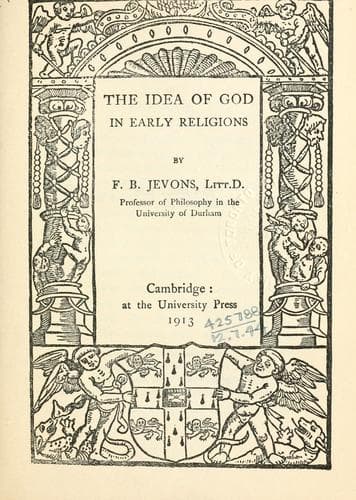
The Idea of God in Early ReligionsJevons, F. B. (Frank Byron)
Religion
The Idea of God in Early Religions
Jevons, F. B. (Frank Byron)
God; Religion
From the prayers that are offered in early, if not primitive,
religions we may draw with safety some conclusions as to the idea,
which the worshippers had before their minds, of the being to whom
they believed they had access in prayer. He was a being accessible in
prayer; and he had it in his power, and, if properly approached, in
his will, to deliver the community from material and external evils.
The spirit in which he was to be properly approached was one of
confession and repentance of offences committed against him: the
calamities which fell upon the community were conceived to have fallen
justly. He was not conceived to be offended without a cause. Doubtless
the causes of offence, like the punishments with which they were
visited, were external and visible, in the sense that they could be
discovered and made plain to all who were concerned to recognise
them. The offences were actions which not only provoked the wrath of
the god, but were condemned by the community. They included offences
which were purely formal and external; and, in the case of some
peoples, the number of such offences probably increased rather than
diminished as time went on. The _Surpu_ tablets of the cuneiform
inscriptions, which are directed towards the removal of the _mamit_,
the ban or taboo, consequent upon such offences, are an example of
this. Adultery, murder and theft are included amongst the offences,
but the tablets include hundreds of other offences, which are purely
ceremonial, and which probably took a long time to reach the luxuriant
growth they have attained in the tablets. For ceremonial offences a
ceremonial purification was felt to suffice. But there were others
which, as the Babylonian Penitential Psalms testify, were felt to go
deeper and to be sins, personal sins of the worshipper against his
God. The penitent exclaims:
'Lord, my sins are many, great are my misdeeds.'
The spirit, in which he approaches his God, is expressed in the words:
'I thy servant, full of sighs, call upon thee.
Like the doves do I moan, I am o'ercome with sighing,
With lamentation and groaning my spirit is downcast.'
His prayer is that his trespasses may be forgiven:
'Rend my sins, like a garment!
My God, my sins are unto seven times seven.
Forgive my iniquities.'
And his hope is in God:
'Oh, Lord, thy servant, cast him not away,
The sins which I have committed, transform by thy grace!'
The attitude of mind, the relation in which the worshipper finds
himself to stand towards his God, is the same as that revealed in the
Psalm of David:
'Wash me throughly from mine iniquity,
And cleanse me from my sin.
For I acknowledge my transgressions:
And my sin is ever before me.
Against thee, thee only, have I sinned.
Cast me not away from thy presence.'
Public-domain text, read in full here on John Shaqi.
Reviews
Reviews
No reviews yet
Be the first to share your thoughts on this work.
Elsewhere in the archive
Join the Discussion
Join the discussion
Sign in to leave a comment or review.
Sign InorCreate an account