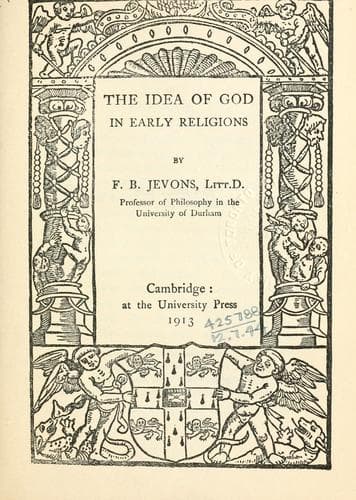
The Idea of God in Early ReligionsJevons, F. B. (Frank Byron)
Religion
The Idea of God in Early Religions
Jevons, F. B. (Frank Byron)
God; Religion
But prayers offered in time of trouble, though they be, or if they be,
the earliest, are not the only prayers that are offered by early man.
Man's wishes are not, and never were, limited: escape from calamity is
not, and never has been, the only thing for which man is capable of
wishing. It certainly is not the only thing for which he has been
capable of praying. Even early man wishes for material blessings: the
kindly fruits of the earth and his daily food are things for which he
not only works but also prays. The negro on the Gold Coast prays for
his daily rice and yams, the Zulu for cattle and for corn, the Samoan
for abundant food, the Finno-Ugrian for rain to make his crops grow;
the Peruvian prayed for health and prosperity. And when man has
attained his wish, when his prayers have been granted, he does not
always forget to render thanks to the god who listened to his prayer.
'Thank you, gods'; says the Basuto, 'give us bread to-morrow also.'
Whether the prayer be for food, or for deliverance from calamity, the
natural tendency is for gratitude and thanks to follow, when the
prayer has been fulfilled; and the mental attitude, or mood of
feeling, is then no longer one of hope or fear, but of thankfulness
and praise. It is in its essence, potentially and, to varying degrees,
actually, the mood of veneration and adoration.
'My lips shall praise thee,
So will I bless thee while I live:
I will lift up my hands in thy name,
And my mouth shall praise thee with joyful lips.'
Public-domain text, read in full here on John Shaqi.
Reviews
Reviews
No reviews yet
Be the first to share your thoughts on this work.
Elsewhere in the archive
Join the Discussion
Join the discussion
Sign in to leave a comment or review.
Sign InorCreate an account