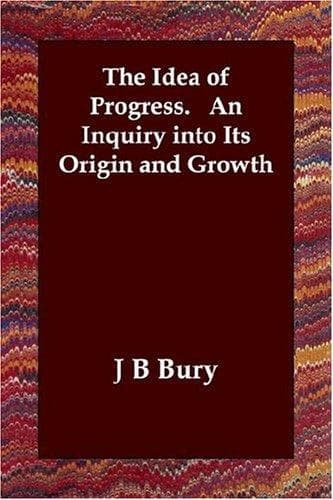
The Idea of Progress: An Inquiry into Its Origin and Growth — John Shaqi
The Idea of Progress: An Inquiry into Its Origin and GrowthBury, J. B. (John Bagnell)
Philosophy
The Idea of Progress: An Inquiry into Its Origin and Growth
Bury, J. B. (John Bagnell)
History -- Philosophy; Progress
But they do decline. Human things are not perpetual; all pass through
the same cycle--beginning, progress, perfection, corruption, end. This,
however, does not explain the succession of empires in the world, the
changes of the scene of prosperity from one people or set of peoples
to another. Le Roy finds the cause in providential design. God, he
believes, cares for all parts of the universe and has distributed
excellence in arms and letters now to Asia, now to Europe, again to
Africa, letting virtue and vice, knowledge and ignorance travel from
country to country, that all in their turn may share in good and bad
fortune, and none become too proud through prolonged prosperity.
But what of the modern age in Western Europe? It is fully the equal, he
assevers, of the most illustrious ages of the past, and in some respects
it is superior. Almost all the liberal and mechanical arts of antiquity,
which had been lost for about 1200 years, have been restored, and
there have been new inventions, especially printing, and the mariner's
compass, and "I would give the third place to gunnery but that it seems
invented rather for the ruin than for the utility of the human race." In
our knowledge of astronomy and cosmography we surpass the ancients. "We
can affirm that the whole world is now known, and all the races of men;
they can interchange all their commodities and mutually supply their
needs, as inhabitants of the same city or world-state." And hence there
has been a notable increase of wealth.
Vice and suffering, indeed, are as grave as ever, and we are afflicted
by the trouble of heresies; but this does not prove a general
deterioration of morals. If that inveterate complaint, the refrain
chanted by old men in every age, were true, the world would already
have reached the extreme limit of wickedness, and integrity would have
disappeared utterly. Seneca long ago made the right criticism. Hoc
maiores nostri questi sunt, hoc nos querimur, hoc posteri nostri
querentur, eversos esse mores.... At ista stant loco eodem. Perhaps
Le Roy was thinking particularly of that curious book the Apology for
Herodotus, in which the eminent Greek scholar, Henri Estienne, exposed
with Calvinistic prejudice the iniquities of modern times and the
corruption of the Roman Church. [Footnote: L'Introduction au traite
de la conformite des merveilles anciennes avec les modernes, ou traite
preparatif a l'Apologie pour Herodote, ed. Ristelhuber, 2 vols., 1879.
The book was published in 1566.]
But if we are to judge by past experience, does it not follow that this
modern age must go the same way as the great ages of the past which
it rivals or even surpasses? Our civilisation, too, having reached
perfection, will inevitably decline and pass away: is not this the clear
lesson of history? Le Roy does not shirk the issue; it is the point to
which his whole exposition has led and he puts it vividly.
Public-domain text, read in full here on John Shaqi.
Reviews
Reviews
No reviews yet
Be the first to share your thoughts on this work.
Join the Discussion
Join the discussion
Sign in to leave a comment or review.
Sign InorCreate an account