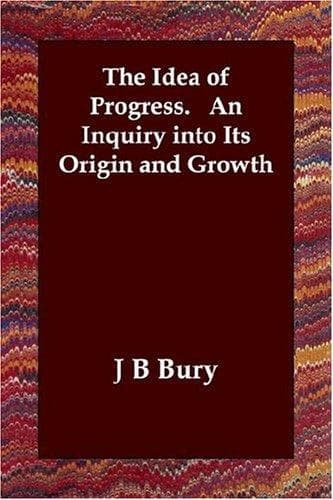
The Idea of Progress: An Inquiry into Its Origin and Growth — John Shaqi
The Idea of Progress: An Inquiry into Its Origin and GrowthBury, J. B. (John Bagnell)
Philosophy
The Idea of Progress: An Inquiry into Its Origin and Growth
Bury, J. B. (John Bagnell)
History -- Philosophy; Progress
It must also be remembered that the principle which he laid down in his
ambitious programme for the reform of science--that experiment is the
key for discovering the secrets of nature--was not a new revelation. We
need not dwell on the fact that he had been anticipated by Roger Bacon;
for the ideas of that wonderful thinker had fallen dead in an age
which was not ripe for them. But the direct interrogation of nature
was already recognised both in practice and in theory in the sixteenth
century. What Bacon did was to insist upon the principle more strongly
and explicitly, and to formulate it more precisely. He clarified and
explained the progressive ideas which inspired the scientific thought
of the last period of the European Renaissance, from which he cannot, I
think, be dissociated.
But in clearing up and defining these progressive ideas, he made a
contribution to the development of human thought which had far-reaching
importance and has a special significance for our present subject. In
the hopes of a steady increase of knowledge, based on the application of
new methods, he had been anticipated by Roger Bacon, and further back
by Seneca. But with Francis Bacon this idea of the augmentation of
knowledge has an entirely new value. For Seneca the exploration of
nature was a means of escaping from the sordid miseries of life. For the
friar of Oxford the principal use of increasing knowledge was to prepare
for the coming of Antichrist. Francis Bacon sounded the modern note; for
him the end of knowledge is utility. [Footnote; The passages specially
referred to are: De Aug. Sc. vii. i; Nov. Org. i. 81 and 3.]
2.
The principle that the proper aim of knowledge is the amelioration
of human life, to increase men's happiness and mitigate their
sufferings--commodis humanis inservire--was the guiding star of Bacon
in all his intellectual labour. He declared the advancement of "the
happiness of mankind" to be the direct purpose of the works he had
written or designed. He considered that all his predecessors had gone
wrong because they did not apprehend that the finis scientarum, the real
and legitimate goal of the sciences, is "the endowment of human life
with new inventions and riches"; and he made this the test for defining
the comparative values of the various branches of knowledge.
Public-domain text, read in full here on John Shaqi.
Reviews
Reviews
No reviews yet
Be the first to share your thoughts on this work.
Join the Discussion
Join the discussion
Sign in to leave a comment or review.
Sign InorCreate an account