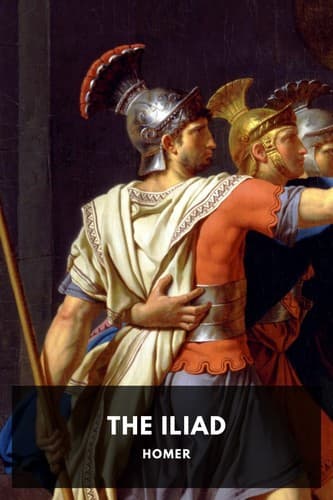
Achilles (Mythological character); Classical literature; Epic poetry, Greek -- Translations into English; Trojan War
As he spoke Patroclus put on his armour. First he greaved his
legs with greaves of good make, and fitted with ancle-clasps of
silver; after this he donned the cuirass of the son of Aeacus,
richly inlaid and studded. He hung his silver-studded sword of
bronze about his shoulders, and then his mighty shield. On his
comely head he set his helmet, well wrought, with a crest of
horse-hair that nodded menacingly above it. He grasped two
redoubtable spears that suited his hands, but he did not take the
spear of noble Achilles, so stout and strong, for none other of
the Achaeans could wield it, though Achilles could do so easily.
This was the ashen spear from Mount Pelion, which Chiron had cut
upon a mountain top and had given to Peleus, wherewith to deal
out death among heroes. He bade Automedon yoke his horses with
all speed, for he was the man whom he held in honour next after
Achilles, and on whose support in battle he could rely most
firmly. Automedon therefore yoked the fleet horses Xanthus and
Balius, steeds that could fly like the wind: these were they whom
the harpy Podarge bore to the west wind, as she was grazing in a
meadow by the waters of the river Oceanus. In the side traces he
set the noble horse Pedasus, whom Achilles had brought away with
him when he sacked the city of Eetion, and who, mortal steed
though he was, could take his place along with those that were
immortal.
Meanwhile Achilles went about everywhere among the tents, and
bade his Myrmidons put on their armour. Even as fierce ravening
wolves that are feasting upon a homed stag which they have killed
upon the mountains, and their jaws are red with blood—they go in
a pack to lap water from the clear spring with their long thin
tongues; and they reek of blood and slaughter; they know not what
fear is, for it is hunger drives them—even so did the leaders and
counsellors of the Myrmidons gather round the good squire of the
fleet descendant of Aeacus, and among them stood Achilles himself
cheering on both men and horses.
Public-domain text, read in full here on John Shaqi.
Reviews
Reviews
No reviews yet
Be the first to share your thoughts on this work.
Elsewhere in the archive
Join the Discussion
Join the discussion
Sign in to leave a comment or review.
Sign InorCreate an account